Unified.Json
3.0.0
dotnet add package Unified.Json --version 3.0.0
NuGet\Install-Package Unified.Json -Version 3.0.0
<PackageReference Include="Unified.Json" Version="3.0.0" />
<PackageVersion Include="Unified.Json" Version="3.0.0" />
<PackageReference Include="Unified.Json" />
paket add Unified.Json --version 3.0.0
#r "nuget: Unified.Json, 3.0.0"
#:package Unified.Json@3.0.0
#addin nuget:?package=Unified.Json&version=3.0.0
#tool nuget:?package=Unified.Json&version=3.0.0
Unified Id - the identity of your data.



Why
What is Unified Id? If GUID is too heavy for your application but you need a random global Id that can be used as a string or long basic type, you are in right place.
What are the main advantages?
| Feature | Unified | GUID |
|---|---|---|
| Size | 8 byte (13 as string) | 16 byte (36 as string) |
| Partitioning | Build-in | No, external can be added |
| Collisions | ~2.7% chance at 1B IDs (50% at ~5.06B) | 50% at 2.7e18 IDs |
| Cast | explicit ToString(); implicit(ulong, long) | explicit(byte[], Parse/ToString) |
| Generate | Build-in(byte[], string, GUID) | No, only random NewGuid |
| Null/Empty-handling | Empty is a value; Parse rejects null/blank | Exception |
UnifiedId is a 64-bit FNV-1a value. At 1 billion IDs the chance of at least one collision is ~2.7%; at 10 billion it is ~93% (50% at ~5.06 billion). FNV-1a is not a cryptographic hash — do not use it for passwords, secrets or unguessable tokens. Use a 128-bit identifier when you need a larger collision budget or adversarial resistance.
Getting started
Install the NuGet package and write the following code:
using Unified;

class Program
{
    static void Main()
    {
        var id = UnifiedId.NewId(); // AFHUTVDSGUGVQ
    }
}
You have created your first Unified Id!
Want to use it as a string? var id = UnifiedId.NewId().ToString(); or long? long id = UnifiedId.NewId();
UnifiedId could be used as DDD ValueObject in your entities.
using System.Text.Json;
using Unified;
using Unified.Json;

class User
{
    public UnifiedId UserId { set; get; }
}

class Program
{
    static void Main()
    {
        var user = new User
        {
            UserId = UnifiedId.NewId()
        };

        var options = new JsonSerializerOptions();
        options.Converters.Add(new UnifiedIdJsonConverter());

        var json = JsonSerializer.Serialize(user, options); // { "UserId": "AFHUTVDSGUGVQ" }
    }
}
JSON
The Unified.Json package contains the System.Text.Json converter (UnifiedIdJsonConverter). The old Unified.Text.Json package has been merged into Unified.Json.
using System.Text.Json;
using Unified.Json;

var options = new JsonSerializerOptions();
options.Converters.Add(new UnifiedIdJsonConverter());

var json = JsonSerializer.Serialize(user, options); // { "UserId": "AFHUTVDSGUGVQ" }
The converter also supports UnifiedId as a dictionary key. It writes the canonical 13-character HEX32 string and rejects JSON null and blank values.
Unified.Json 3.0.0 is System.Text.Json-only. The obsolete Newtonsoft.Json UnifiedIdConverter was removed; users who still need it can pin Unified.Json 2.0.1 or migrate to UnifiedIdJsonConverter.
Modern .NET
On modern targets (net10.0) UnifiedId implements IParsable<UnifiedId>, ISpanParsable<UnifiedId>, IFormattable and ISpanFormattable, so it participates in generic parsing, ASP.NET Core model binding and allocation-free (Span-based) formatting — and can serve as the backing value for strongly-typed id libraries. The package multi-targets netstandard2.0;net10.0.
Native AOT
The Unified and Unified.Json packages are built with IsAotCompatible=true on modern targets and Directory.Build.props promotes trim/AOT analyzer warnings to errors, so UnifiedId and the System.Text.Json converter stay reflection-free and work with PublishAot.
When using System.Text.Json in Native AOT, register UnifiedIdJsonConverter and supply source-generated metadata (JsonSerializerContext) for your containing types; reflection-based serialization is disabled by default in AOT. The converter itself is allocation-free on net10.0. Unified.Json 3.0.0 no longer depends on Newtonsoft.Json.
Benchmarks
The benchmarks/Unified.Benchmarks project uses BenchmarkDotNet with MemoryDiagnoser:
dotnet run -c Release --project benchmarks/Unified.Benchmarks -- --filter "*" -j short
The core hot paths (Parse, TryParse, TryFormat, Equals, the factories, PartitionNumber, and the System.Text.Json converter) allocate 0 B. APIs that return a new string (ToString, PartitionKey, PartitionNumberAsString) allocate only the resulting string. test/Unified.Tests/AllocationTests.cs enforces the 0-allocation paths in the test suite.
How it works
using Unified;

class Program
{
    static void Main()
    {
        var guid = Guid.NewGuid();
        var id = UnifiedId.FromGuid(guid);
        var fnv = id.ToUInt64();
        Console.WriteLine($"{guid} => {fnv} => {id}");
        // 8dd02ad1-62cc-4015-9502-49658ba240ae => 15834445116674749764 => DNFPVU1LD2DA4
    }
}
Unified Id generates 64bit FNV-1a Id's based on GUID and converts it to HEX32 to use as string. FNV-1a is fast and non-cryptographic; do not use it for passwords, secrets or unguessable tokens.
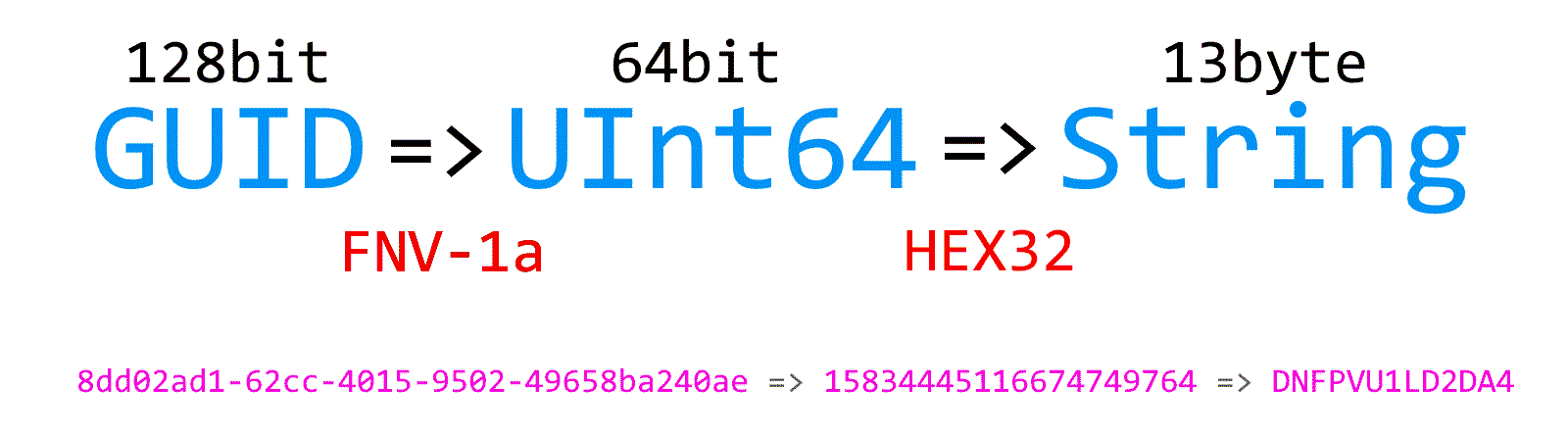
HEX32 is reversible, so you can convert it back from string to UInt64.
ulong number = UnifiedId.Parse("DNFPVU1LD2DA4");
Why FNV-1a 64bit? because it has the best space randomization in the case of GUID conversion, below is space representation.

Default method of generation is GUID based using method var id = UnifiedId.NewId();.
This value could be used as string converted in HEX32 consisting of two parts.
[KEY][UNIFIED_ID] KEY - Partition/Shard Key and UNIFIED_ID as Row Unified Key together used as the global identity.
You can also generate this Id as a 64-bit FNV-1a fingerprint (not cryptographic) using the following sources:
UnifiedId FromGuid(Guid id)UnifiedId FromBytes(byte[] bytes)UnifiedId FromString(string text)UnifiedId FromInt64(long number)UnifiedId FromUInt64(ulong number)
Do you need sequential Id? var id = new UnifiedId(DateTime.UtcNow.Ticks)
Want to save partitioned data? It's easy...
using Unified;
using System;

class Program
{
    static void Main()
    {
        // Let's emulate the partitioned database.
        var db = new Dictionary<string, List<UnifiedId>>();

        // We will use 10M records, just to execute it fast.
        var all = 10000000;
        for (var i = 0; i <= all; i++)
        {
            // Generate random Id.
            var id = UnifiedId.NewId();

            // Get it's partition key. Number of partitions could be customized, default 16K.
            var partition = id.PartitionKey();

            // Initialize partitions in your DB.
            if (!db.ContainsKey(partition))
            {
                db.Add(partition, new List<UnifiedId>());
            }

            // Add values to partitions.
            db[partition].Add(id);
        }
    }
}
Result:
DB Count             : 16384
Each item contain    : 610 elements +/-5%
64-bit FNV-1a has a birthday bound: ~2.7% chance of at least one collision at 1 billion IDs and ~93% at 10 billion. Treat 64-bit IDs as unsuitable when you need guaranteed uniqueness at that scale; handle collisions or use a 128-bit identifier.
© 2021 Serhii Seletskyi. All rights reserved.
| Product | Versions Compatible and additional computed target framework versions. |
|---|---|
| .NET | net5.0 was computed. net5.0-windows was computed. net6.0 was computed. net6.0-android was computed. net6.0-ios was computed. net6.0-maccatalyst was computed. net6.0-macos was computed. net6.0-tvos was computed. net6.0-windows was computed. net7.0 was computed. net7.0-android was computed. net7.0-ios was computed. net7.0-maccatalyst was computed. net7.0-macos was computed. net7.0-tvos was computed. net7.0-windows was computed. net8.0 was computed. net8.0-android was computed. net8.0-browser was computed. net8.0-ios was computed. net8.0-maccatalyst was computed. net8.0-macos was computed. net8.0-tvos was computed. net8.0-windows was computed. net9.0 was computed. net9.0-android was computed. net9.0-browser was computed. net9.0-ios was computed. net9.0-maccatalyst was computed. net9.0-macos was computed. net9.0-tvos was computed. net9.0-windows was computed. net10.0 is compatible. net10.0-android was computed. net10.0-browser was computed. net10.0-ios was computed. net10.0-maccatalyst was computed. net10.0-macos was computed. net10.0-tvos was computed. net10.0-windows was computed. |
| .NET Core | netcoreapp2.0 was computed. netcoreapp2.1 was computed. netcoreapp2.2 was computed. netcoreapp3.0 was computed. netcoreapp3.1 was computed. |
| .NET Standard | netstandard2.0 is compatible. netstandard2.1 was computed. |
| .NET Framework | net461 was computed. net462 was computed. net463 was computed. net47 was computed. net471 was computed. net472 was computed. net48 was computed. net481 was computed. |
| MonoAndroid | monoandroid was computed. |
| MonoMac | monomac was computed. |
| MonoTouch | monotouch was computed. |
| Tizen | tizen40 was computed. tizen60 was computed. |
| Xamarin.iOS | xamarinios was computed. |
| Xamarin.Mac | xamarinmac was computed. |
| Xamarin.TVOS | xamarintvos was computed. |
| Xamarin.WatchOS | xamarinwatchos was computed. |
-
.NETStandard 2.0
- System.Text.Json (>= 10.0.0)
- Unified (>= 2.0.1)
-
net10.0
- Unified (>= 2.0.1)
NuGet packages
This package is not used by any NuGet packages.
GitHub repositories
This package is not used by any popular GitHub repositories.
3.0.0: System.Text.Json only; removed the obsolete Newtonsoft.Json converter. The package is AOT-compatible.