Rezoom 2.0.0
dotnet add package Rezoom --version 2.0.0
NuGet\Install-Package Rezoom -Version 2.0.0
<PackageReference Include="Rezoom" Version="2.0.0" />
<PackageVersion Include="Rezoom" Version="2.0.0" />
<PackageReference Include="Rezoom" />
paket add Rezoom --version 2.0.0
#r "nuget: Rezoom, 2.0.0"
#:package Rezoom@2.0.0
#addin nuget:?package=Rezoom&version=2.0.0
#tool nuget:?package=Rezoom&version=2.0.0
What's this?
Rezoom is a library intended to reduce the pain of dealing with data that lives across a latency boundary.
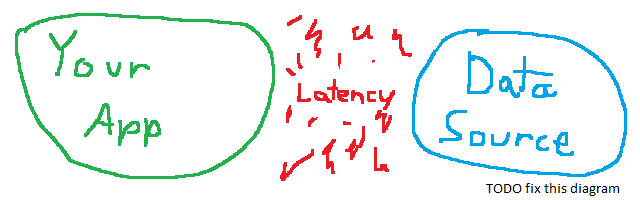
Common examples of this nightmare include SQL databases, NoSQL databases, and web APIs.
It tends to be hard to write abstractions over these data sources because the round-trip time dominates all other performance concerns, and it's impossible to optimize without breaking your API.
If somebody is calling GetUserDetails(userId) in a loop for 500 different
users, you really can't help them other than by convincing them to switch to
GetMultipleUserDetails(all500userIds).
Rezoom lets you write little units of business logic called Plans (like the
aforementioned GetUserDetails), which you can then glue together into larger
plans. It'll handle converting the 500 independent GetUserDetails calls into
one GetMultipleUserDetails call. It also de-duplicates redundant requests: for
example if multiple functions need to query for the current user's permissions,
only one such query will actually be executed.
Show me an example so I know whether to care
Here's some contrived example code. You can write a Rezoom wrapper library for any data source, but it comes with one called Rezoom.SQL that statically typechecks SQL and infers its caching behavior.
type GetPerson = SQL<"select * from People where Id = @id">
type GetCompany = SQL<"select * from Companies where Id = @id">

/// Gets a person and their employer. This implementation takes 2 round trips.
let getPersonAndEmployer (personId : int) : (GetPerson.Row * GetCompany.Row) Plan =
    plan {
        // One round trip.
        let! person = GetPerson.Command(id = personId).ExactlyOne()
        // Another round trip.
        let! employer = GetCompany.Command(id = person.EmployerId).ExactlyOne()
        return (person, employer)
    }

let example =
    plan {
        // Two round-trips: one to get both users, another to get both employers.
        // If the two users have the same employer, the 2nd round-trip will only include one SELECT statement.
        let! (user1, employer1), (user2, employer2) =
            getPersonAndEmployer 1, getPersonAndEmployer 2
        printfn "%s is employed by %, %s by %s"
            user1.Name, employer1.Name
            user2.Name, employer2.Name

        // Two more round trips: again, the user queries all share one, and the employer queries share the next.
        for id in batch [ 3; 4; 5; 6 ] do
            let! user, employer = getPersonAndEmployer id
            printfn "%s is employed by %s" user.Name, employer.Name
    }
Pretty neat, huh? How about this?
type UpdateCompanies = SQL<"update Companies set LastUpdatedUtc = SysUtcDateTime() where Id = 27">

let example2 =
    plan {
        // Two round-trips: one for the user, one for the employer.
        let! (user1, employer1) =
            getPersonAndEmployer 1

        // Zero round trips, because both query results are cached.
        let! (user1Again, employer1Again) =
            getPersonAndEmployer 1

        // Invalidates the cache for all queries dependent on the Companies table.
        // This is automatically deduced by the SQL<"query string"> type provider.
        do! UpdateCompanies.Command().Plan()

        // One round-trip: user is still cached, but we have to reload the employer.
        let! (user1Again, employer1Again) =
            getPersonAndEmployer 1

        return 0
    }
"Now, hang on a minute," you might be asking your computer screen. "Where's this stuff being cached? What if some other code updates a table and now the cache is invalid?"
When you write a plan block nothing happens until you execute it with
Execution.execute(plan). The cache is local to that execution, which is also
implicitly wrapped in a transaction. So, the cache is not for keeping
information across, say, multiple requests to your website.
It's to eliminate the temptation to explicitly pass around loaded data, cluttering your API in an attempt to save queries.
The idea is to let you write very fine-grained APIs that take the bare minimum
of information (like deleteSlide : SlideId -> unit Plan) but can be composed
together without creating a performance nightmare.
| Product | Versions Compatible and additional computed target framework versions. |
|---|---|
| .NET | net5.0 was computed. net5.0-windows was computed. net6.0 was computed. net6.0-android was computed. net6.0-ios was computed. net6.0-maccatalyst was computed. net6.0-macos was computed. net6.0-tvos was computed. net6.0-windows was computed. net7.0 was computed. net7.0-android was computed. net7.0-ios was computed. net7.0-maccatalyst was computed. net7.0-macos was computed. net7.0-tvos was computed. net7.0-windows was computed. net8.0 is compatible. net8.0-android was computed. net8.0-browser was computed. net8.0-ios was computed. net8.0-maccatalyst was computed. net8.0-macos was computed. net8.0-tvos was computed. net8.0-windows was computed. net9.0 was computed. net9.0-android was computed. net9.0-browser was computed. net9.0-ios was computed. net9.0-maccatalyst was computed. net9.0-macos was computed. net9.0-tvos was computed. net9.0-windows was computed. net10.0 is compatible. net10.0-android was computed. net10.0-browser was computed. net10.0-ios was computed. net10.0-maccatalyst was computed. net10.0-macos was computed. net10.0-tvos was computed. net10.0-windows was computed. |
| .NET Core | netcoreapp2.0 was computed. netcoreapp2.1 was computed. netcoreapp2.2 was computed. netcoreapp3.0 was computed. netcoreapp3.1 was computed. |
| .NET Standard | netstandard2.0 is compatible. netstandard2.1 was computed. |
| .NET Framework | net461 was computed. net462 was computed. net463 was computed. net47 was computed. net471 was computed. net472 was computed. net48 was computed. net481 was computed. |
| MonoAndroid | monoandroid was computed. |
| MonoMac | monomac was computed. |
| MonoTouch | monotouch was computed. |
| Tizen | tizen40 was computed. tizen60 was computed. |
| Xamarin.iOS | xamarinios was computed. |
| Xamarin.Mac | xamarinmac was computed. |
| Xamarin.TVOS | xamarintvos was computed. |
| Xamarin.WatchOS | xamarinwatchos was computed. |
-
.NETStandard 2.0
- FSharp.Core (>= 8.0.401)
-
net10.0
- FSharp.Core (>= 8.0.401)
-
net8.0
- FSharp.Core (>= 8.0.401)
NuGet packages (2)
Showing the top 2 NuGet packages that depend on Rezoom:
| Package | Downloads |
|---|---|
|
Rezoom.SQL.Mapping
Mapping / data reader infrastructure for Rezoom.SQL. |
|
|
Rezoom.SQL.Compiler
Compiler and dialect translators for Rezoom.SQL. |
GitHub repositories
This package is not used by any popular GitHub repositories.
Modernized for the 2026 .NET ecosystem after a long dormancy. Multi-targets netstandard2.0, net8.0, and net10.0. Drops embedded TaskBuilder.fs in favor of FSharp.Core's built-in `task { }` (requires FSharp.Core 8.0.401+). Replaces the custom IServiceConfig with the standard IServiceProvider. Adds PlanExecutor for DI-friendly plan execution. ServiceContext renamed to PlanContext. Breaking changes for code that used the old service-config API.