LexiSharp 0.8.0
dotnet add package LexiSharp --version 0.8.0
NuGet\Install-Package LexiSharp -Version 0.8.0
<PackageReference Include="LexiSharp" Version="0.8.0" />
<PackageVersion Include="LexiSharp" Version="0.8.0" />
<PackageReference Include="LexiSharp" />
paket add LexiSharp --version 0.8.0
#r "nuget: LexiSharp, 0.8.0"
#:package LexiSharp@0.8.0
#addin nuget:?package=LexiSharp&version=0.8.0
#tool nuget:?package=LexiSharp&version=0.8.0
LexiSharp






A composable information retrieval toolkit for .NET — build, measure and inspect search pipelines, from lexical BM25 to hybrid and reranked retrieval.
Index, retrieve, rank and judge a search pipeline: an in-memory inverted index, four ranking strategies and their BM25 variants, rank fusion, reranking, optional PostgreSQL backends, and model-agnostic seams for dense, learned-sparse and neural scoring — the models stay in your application. The core package references no NuGet package at all.
📖 Full documentation → — the guide, the
reference, and every measurement with the command that reproduces it. Published from
docs/; this README is the short version and the details are delegated to those
pages.
Install
dotnet add package LexiSharp # the core: index, scorers, engines, decorators — no dependencies
net10.0, MIT. Optional: LexiSharp.MessagePack (binary index persistence),
LexiSharp.AspNetCore (a GET /search minimal-API endpoint), LexiSharp.Postgres
(lexical, vector, sparse, fuzzy and true BM25 backends) — packages.
Use it
using LexiSharp.Core;
using LexiSharp.Indexing;
using LexiSharp.Ranking;

// Three pieces, one contract: the index owns the corpus statistics, the scorer is a pure
// ranking strategy reading from it, the engine orchestrates. Each of the three is an
// interface, so you replace one without touching the others.
ITextSearchEngine engine = new RankedTextSearchEngine(
    new InMemoryTextIndex(),
    new Bm25Scorer());

engine.Index(new[]
{
    new SearchDocument("1", "The search engine uses BM25 to rank the results"),
    new SearchDocument("2", "TF-IDF is a classic method of textual search"),
    new SearchDocument("3", "Italian cuisine is renowned in Rome"),
});

foreach (var result in engine.Search("textual search"))
    Console.WriteLine($"{result.DocumentId} - {result.Score:0.###}: {result.Document.Text}");
That is the smallest thing the library does. The rest is composition: every engine above
implements ITextSearchEngine, and a pipeline is stages wrapping each other. Given two
engines over one index, HashingEmbeddingProvider standing in for your
IEmbeddingProvider (no model, no service):
var hybrid = new HybridTextSearchEngine(
    new[] { lexical, dense },
    new ReciprocalRankFusionMerger());   // a BM25 score and a cosine, fused by rank, uncalibrated

ITextSearchEngine pipeline = new RerankedTextSearchEngine(
    hybrid, new ProximityReranker(index));   // ...or MMR, a cascade, MaxSim, a cross-encoder
Replacing a piece is the whole extension model — a PostgreSQL, vector, sparse or fuzzy
backend takes the same slot, and IEmbeddingProvider, ISparseEmbeddingProvider and
ICrossEncoderScorer are yours to implement: pipelines, and
backends.
LexiSharpIndex<T> is the typed facade over the same engine if you would rather hand it your
own objects — Getting started.
See it running
dotnet run --project samples/LexiSharp.Demo # → http://localhost:5000
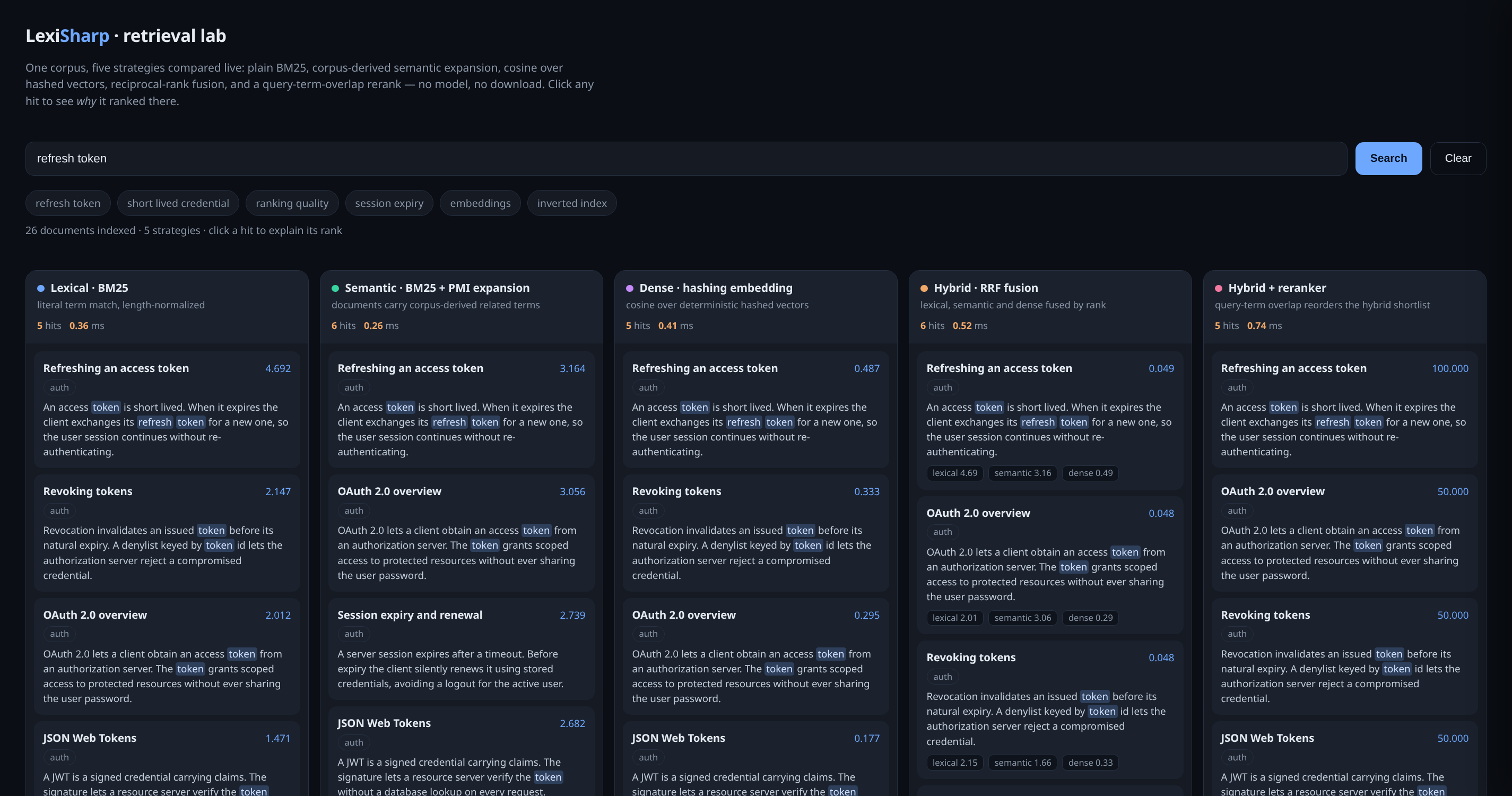
Five retrieval strategies over one corpus, compared live — BM25, corpus-derived semantic expansion, dense hashing embeddings, RRF fusion and a term-overlap rerank — with per-lane latency, highlighting and a click-through "why did this rank here?" panel. No model, no external service.
The corpus is the built-in one, written for the demo. --corpus runs the same five lanes over a
BEIR corpus instead — nfcorpus, scifact or arguana — read from the evaluation harness's data
directory, which the harness downloads on first use:
dotnet run --project samples/LexiSharp.Demo -- --corpus scifact
The example queries come from the corpus's own queries.jsonl, restricted to the ones carrying a
positive judgement in qrels/test.tsv. The demo builds a BEIR corpus's documents the way
the harness does — title as a text field, body as the text — but it does
not rank it identically, because the two tokenize differently: the demo removes stop words and the
harness's default analysis does not. On NFCorpus, 5 of the 6 example queries come back with a
different top-10 ordering, for a mean top-10 overlap of 6.67. Compare a demo figure against the
harness by running the harness.
--segmentation picks how a separator inside a word is treated: uax29 (the default) or flat.
Under flat every non-word character ends a word, so 1,000 indexes as the term 000 and
don't as don; under uax29 a comma between two digits and an apostrophe within one class stay
in the token. It decides which tokens exist, so every lane uses it — a page comparing two lanes
under two segmentations would be comparing tokenizers.
What it does not do
Stated plainly, so nothing is implied. The full list, with the measurement behind each claim, is Scope and limits.
- It matches the published BM25 baseline on all three corpora it can be compared on. On NFCorpus
and SciFact, with the analysis, the BM25 parameters and the metric convention aligned to those the
reference figures were produced with, the plain BM25 scorer reaches nDCG@10 0.3215 and
0.6788 against 0.3218 and 0.6789 — equal to the fourth decimal. On ArguAna, at the
reference's own k1=0.9/b=0.4, it reaches 0.3970 against the 0.3970 that implementation
publishes, and recall@100 0.9324 against 0.9324. That last one is not measured only by this
harness:
trec_eval— the standard evaluator, not this repository's code — reads both figures off a run this harness writes, and the 15,466 returned scores for the 1,406 queries match the reference's own searcher on the raw bits, so the ranking is that ranking rather than a lookalike. The same scores read under the library defaults are 0.308 / 0.662 / 0.320; that difference is the analyzer, the parameters and one task convention, not the ranking. Corpora are md5-verified on download, and the numbers are pinned and re-checked by thePinned referenceworkflow, which replays every pinned configuration and exits non-zero on drift. It runs on a dispatch, on a push that touches the library or the harness, and weekly — see evaluation. - An earlier figure published for ArguAna was withdrawn; it is not reproducible by any code path in this repository. See the changelog.
- No scorer here has a measured win over a tuned BM25. BM25+ and BM25L, tuned on their own
δ, tie a tuned BM25 on the reference corpus and NFCorpus and edge it by 0.002–0.004 on SciFact — an in-sample margin, so an upper bound rather than a result. On ArguAna, untuned, they lose, and noδ-tuned ArguAna row exists, so whether tuning closes that gap is unmeasured (ranking). - The SQL backends' retrieval quality is unmeasured. The BEIR numbers come from the in-memory engines; the live integration tests cover schema, query paths and cosine behaviour, not relevance (backends).
- Not every combination is tested. Engines, scorers, rerankers and mergers are tested individually and in the combinations described, but not every pairing — treat an unusual one as supported but unproven until you test it on your data.
- Version 0.8.0, one maintainer. The public API may still change between minor versions —
pin a version and read the release notes. 0.8.0 breaks two things:
QueryFeatures.Phrasesreplaces the pair ofparent/childfeatures on the central record, andAccumulateFilteredQueriesnow defaults to the fast path.
Development
dotnet build LexiSharp.slnx
dotnet test  tests/LexiSharp.Tests   # xUnit suite; the Postgres suites need POSTGRES_TEST_CONNECTION
The retrieval quality gate replays every pinned configuration on the three BEIR corpora and exits non-zero on any drift. It downloads the corpora on first run, so it is not part of the xUnit suite:
dotnet run --project bench/LexiSharp.Eval -c Release -- --verify-reference
Benchmarks, the evaluation harness and the behavioural gate: Reference and Benchmarks.
License
MIT — see LICENSE. The ParadeDB pg_search extension used by the BM25 backend is
licensed separately, under AGPL-3.
| Product | Versions Compatible and additional computed target framework versions. |
|---|---|
| .NET | net10.0 is compatible. net10.0-android was computed. net10.0-browser was computed. net10.0-ios was computed. net10.0-maccatalyst was computed. net10.0-macos was computed. net10.0-tvos was computed. net10.0-windows was computed. |
-
net10.0
- No dependencies.
NuGet packages (3)
Showing the top 3 NuGet packages that depend on LexiSharp:
| Package | Downloads |
|---|---|
|
LexiSharp.AspNetCore
ASP.NET Core integration for LexiSharp: a minimal-API search endpoint on top of LexiSharpIndex<T>. |
|
|
LexiSharp.MessagePack
MessagePack persistence for the LexiSharp in-memory text index: save and reload a full corpus as compact binary. |
|
|
LexiSharp.Postgres
PostgreSQL backends for LexiSharp: lexical full-text search on tsvector, ANN on pgvector, sparse retrieval, fuzzy search on pg_trgm, and true Okapi BM25 on the ParadeDB pg_search (Tantivy) extension. |
GitHub repositories
This package is not used by any popular GitHub repositories.