CancelCop.Analyzer
1.37.0
See the version list below for details.
dotnet add package CancelCop.Analyzer --version 1.37.0
NuGet\Install-Package CancelCop.Analyzer -Version 1.37.0
<PackageReference Include="CancelCop.Analyzer" Version="1.37.0">
  <PrivateAssets>all</PrivateAssets>
  <IncludeAssets>runtime; build; native; contentfiles; analyzers</IncludeAssets>
</PackageReference>
<PackageVersion Include="CancelCop.Analyzer" Version="1.37.0" />
<PackageReference Include="CancelCop.Analyzer"> <PrivateAssets>all</PrivateAssets> <IncludeAssets>runtime; build; native; contentfiles; analyzers</IncludeAssets> </PackageReference>
paket add CancelCop.Analyzer --version 1.37.0
#r "nuget: CancelCop.Analyzer, 1.37.0"
#:package CancelCop.Analyzer@1.37.0
#addin nuget:?package=CancelCop.Analyzer&version=1.37.0
#tool nuget:?package=CancelCop.Analyzer&version=1.37.0
<p align="center"> <img src="https://raw.githubusercontent.com/georgepwall1991/CancelCop.Analyzer/main/assets/cancelcop-icon.png" width="96" height="96" alt="CancelCop.Analyzer icon — Roslyn analyzer for CancellationToken and async/await in C#/.NET"> </p>
CancelCop.Analyzer
Compile-time CancellationToken and async/await Roslyn analyzer for C#/.NET — catches missing cancellation propagation, ignored ASP.NET Core RequestAborted, EF Core and HttpClient token gaps, sync-over-async deadlocks, blocking I/O, async void, and resource-lifetime bugs so they fail in the editor and CI, not only at runtime.




Stop shipping async that cannot cancel.
The problem
CancellationToken and correct async/await usage are essential for responsive .NET apps, but cancellation bugs hide across API boundaries. A public method without a token, an HttpClient or EF Core call that ignores the caller's token, a controller that never sees RequestAborted, a timeout CTS that drops the parent token, or a .Result / Thread.Sleep inside async code often compiles cleanly and only fails under load, shutdown, or client disconnect.
Runtime review and occasional CA rules miss what a dedicated cancellation-and-async analyzer can prove from your call sites.
What it catches
CancelCop reports high-signal async and cancellation failures early (35 diagnostics, many with code fixes):
- missing
CancellationTokenon public async methods and framework handlers (controllers, Minimal APIs, MediatR, SignalR,BackgroundService) - tokens accepted but not propagated to
HttpClient, EF Core,Task.Delay, and other cancellable APIs - loops and async streams that ignore cancellation (
ThrowIfCancellationRequested,.WithCancellation,[EnumeratorCancellation]) - timeout
CancellationTokenSourcethat silently drops a parent token (CreateLinkedTokenSource+CancelAfter) - sync-over-async and blocking I/O (
.Result/.Wait(),Thread.Sleep,SemaphoreSlim.Wait(), blockingFile/ stream APIs,Process.WaitForExit(), blocking sync primitives) async void, unawaited fire-and-forget calls, swallowedOperationCanceledException, and resource-lifetime bugs (undisposed CTS locals and fields, prematureusingdisposal)
When the analyzer cannot prove a problem statically, it stays quiet. High-signal feedback, not noisy guesses.
Install
<PackageReference Include="CancelCop.Analyzer" Version="1.37.0">
<PrivateAssets>all</PrivateAssets>
<IncludeAssets>runtime; build; native; contentfiles; analyzers</IncludeAssets>
</PackageReference>
Or:
dotnet add package CancelCop.Analyzer
Install-Package CancelCop.Analyzer -Version 1.37.0
No runtime dependency is added to your app. CancelCop runs as a Roslyn analyzer during build and in supported IDEs. Use PrivateAssets="all" so the analyzer stays a development dependency for libraries.
See it work
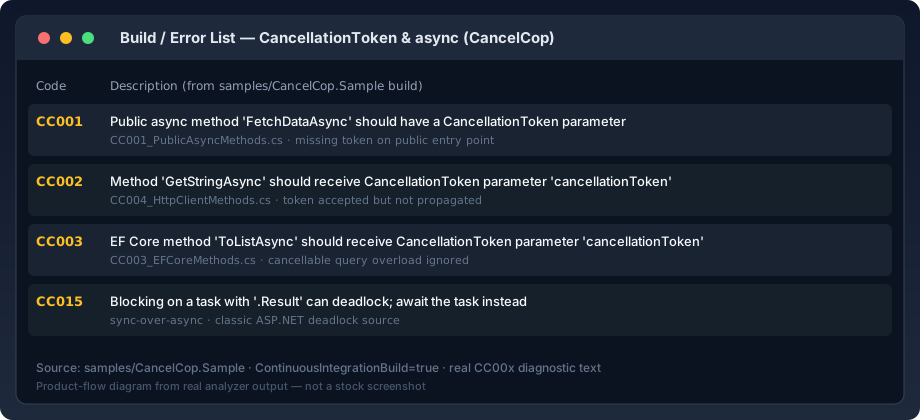
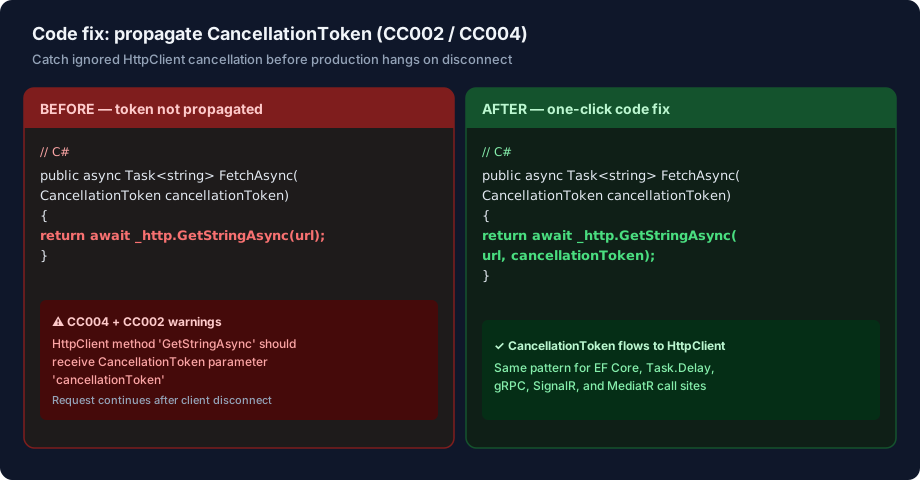
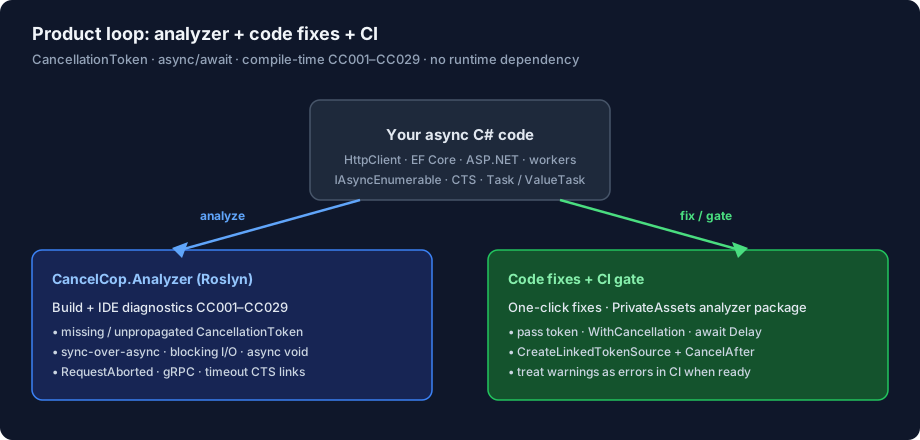
Product-flow diagrams from the real sample build (CC001–CC029 diagnostic text):
1. Build / IDE diagnostics (CancellationToken and async)
2. Before / after code fix (HttpClient token propagation)
3. Product loop — analyzer, code fixes, and CI
30-second path
- Reference the package with
PrivateAssets="all". - Build in the IDE or with
dotnet buildso analyzers run. - Fix any
CC00xwarnings (most have one-click code fixes). - Optionally promote critical rules to errors in
.editorconfigwhen the codebase is clean:
[*.cs]
dotnet_diagnostic.CC002.severity = error
dotnet_diagnostic.CC015.severity = error
- Keep the sample project handy for rule demos:
dotnet build samples/CancelCop.Sample
Feature snapshot
| Area | What CancelCop does |
|---|---|
| Token presence | Flags public/protected async methods and framework handlers missing CancellationToken. |
| Propagation | Requires tokens to flow into HttpClient, EF Core, and other cancellable overloads when a token is in scope. |
| ASP.NET Core | Controllers, Minimal APIs, SignalR hubs, middleware via HttpContext.RequestAborted. |
| Hosted services | BackgroundService.ExecuteAsync must observe the stopping token. |
| gRPC / MediatR | Observes ServerCallContext.CancellationToken and handler signatures. |
| Async streams | await foreach + .WithCancellation; iterators need [EnumeratorCancellation]. |
| Timeout CTS | Links parent tokens with CreateLinkedTokenSource + CancelAfter (CC029). |
| Sync-over-async | .Result / .Wait() / GetAwaiter().GetResult(), Thread.Sleep, SemaphoreSlim.Wait(), blocking file I/O. |
| Async hygiene | async void, void-returning async lambdas, swallowed cancellation, await using, CTS disposal. |
| Code fixes | Most rules offer compilable one-click fixes; Fix All is supported where safe. |
Compatibility
- Analyzer assemblies target .NET Standard 2.0 and compile against Roslyn 4.8 (Visual Studio 2022 17.8+ / .NET SDK 8+ hosts)
- Consumer projects can target any framework supported by a compatible compiler host
- ASP.NET Core, EF Core, HttpClient, gRPC, SignalR, MediatR, BackgroundService
IAsyncEnumerable<T>, ValueTask /ValueTask<T>
Analyzer Rules
| Rule | Description | Severity | Code Fix |
|---|---|---|---|
| CC001 | Public async methods must have CancellationToken parameter | Warning | ✅ |
| CC002 | CancellationToken must be propagated to async calls | Warning | ✅ |
| CC003 | EF Core queries must pass CancellationToken | Warning | ✅ |
| CC004 | HttpClient methods must pass CancellationToken | Warning | ✅ |
| CC005A | MediatR handlers must accept CancellationToken | Warning | ✅ |
| CC005B | Controller actions must accept CancellationToken | Warning | ✅ |
| CC005C | Minimal API endpoints must accept CancellationToken | Warning | ✅ |
| CC006 | CancellationToken should be the last parameter | Info | ❌ |
| CC009 | Loops should check for cancellation | Warning | ✅ |
| CC010 | await foreach should flow a CancellationToken via .WithCancellation |
Warning | ✅ |
| CC011 | Async-iterator CancellationToken should be [EnumeratorCancellation] |
Warning | ✅ |
| CC012 | Avoid passing CancellationToken.None/default when a token is in scope |
Info | ✅ |
| CC013 | Avoid Thread.Sleep in async code; use await Task.Delay |
Warning | ✅ |
| CC014 | CancellationTokenSource should be disposed |
Warning | ✅ |
| CC015 | Avoid blocking on async code (.Result/.Wait()/.GetAwaiter().GetResult()) |
Warning | ✅ |
| CC016 | CancellationToken parameter is accepted but never used |
Info | ❌ |
| CC017 | BackgroundService.ExecuteAsync should observe its stopping token |
Warning | ❌ |
| CC018 | SignalR hub methods should accept a CancellationToken |
Warning | ✅ |
| CC019 | Broad catch swallows OperationCanceledException |
Info | ✅ |
| CC020 | gRPC method should observe ServerCallContext.CancellationToken |
Warning | ❌ |
| CC021 | Method should observe HttpContext.RequestAborted |
Info | ❌ |
| CC022 | Prefer await CancelAsync() over Cancel() in async code |
Info | ✅ |
| CC023 | Avoid async void (non-event-handler) |
Warning | ✅ |
| CC024 | Avoid async lambdas converted to Action |
Warning | ❌ |
| CC025 | Prefer await using for IAsyncDisposable |
Info | ✅ |
| CC026 | Avoid SemaphoreSlim.Wait() in async code; use await WaitAsync() |
Warning | ✅ |
| CC027 | Returned task uses a disposed using resource |
Warning | ❌ |
| CC028 | Avoid blocking System.IO calls (File, StreamReader, StreamWriter, Stream) in async code; use the async counterpart |
Warning | ✅ |
| CC029 | Timeout CancellationTokenSource should link the in-scope token (CreateLinkedTokenSource + CancelAfter) |
Warning | ✅ |
| CC030 | Avoid blocking Process.WaitForExit() in async code; use await WaitForExitAsync(token) |
Warning | ✅ |
| CC031 | Avoid blocking synchronization primitives (ManualResetEventSlim.Wait, WaitHandle.WaitOne, Monitor.Wait, Thread.Join) in async code |
Warning | ❌ |
| CC032 | Async call discarded in non-async code, where the compiler's CS4014 does not fire | Warning | ❌ |
| CC033 | CancellationTokenSource field created by the type and never disposed |
Warning | ❌ |
| CC034 | ParallelOptions created without CancellationToken while a token is in scope |
Warning | ✅ |
| CC035 | Empty catch (OperationCanceledException) silently discards the cancellation |
Info | ❌ |
Quick Examples
CC001: Missing CancellationToken Parameter
// ❌ Warning CC001
public async Task ProcessDataAsync()
{
    await Task.Delay(100);
}

// ✅ Fixed
public async Task ProcessDataAsync(CancellationToken cancellationToken = default)
{
    await Task.Delay(100, cancellationToken);
}
CC002: Token Not Propagated
// ❌ Warning CC002 - token available but not passed
public async Task ProcessAsync(CancellationToken cancellationToken)
{
    await Task.Delay(100);           // Should pass cancellationToken
    await DoWorkAsync();              // Should pass cancellationToken
}

// ✅ Fixed
public async Task ProcessAsync(CancellationToken cancellationToken)
{
    await Task.Delay(100, cancellationToken);
    await DoWorkAsync(cancellationToken);
}
CC003: EF Core Without Token
// ❌ Warning CC003
public async Task<User?> GetUserAsync(int id, CancellationToken cancellationToken)
{
    return await _context.Users.FirstOrDefaultAsync(u => u.Id == id);
}

// ✅ Fixed
public async Task<User?> GetUserAsync(int id, CancellationToken cancellationToken)
{
    return await _context.Users.FirstOrDefaultAsync(u => u.Id == id, cancellationToken);
}
CC004: HttpClient Without Token
// ❌ Warning CC004
public async Task<string> FetchDataAsync(CancellationToken cancellationToken)
{
    return await _httpClient.GetStringAsync("https://api.example.com");
}

// ✅ Fixed
public async Task<string> FetchDataAsync(CancellationToken cancellationToken)
{
    return await _httpClient.GetStringAsync("https://api.example.com", cancellationToken);
}
CC005B: Controller Action Without Token
// ❌ Warning CC005B
[HttpGet]
public async Task<IActionResult> GetUsers()
{
    var users = await _service.GetUsersAsync();
    return Ok(users);
}

// ✅ Fixed - ASP.NET Core injects the token automatically
[HttpGet]
public async Task<IActionResult> GetUsers(CancellationToken cancellationToken)
{
    var users = await _service.GetUsersAsync(cancellationToken);
    return Ok(users);
}
CC005C: Minimal API Without Token
// ❌ Warning CC005C
app.MapGet("/users", async () => await GetUsersAsync());

// ✅ Fixed
app.MapGet("/users", async (CancellationToken ct) => await GetUsersAsync(ct));

// ❌ Warning CC005C — method-group handlers are analysed too (v1.4.4);
// the fix adds `CancellationToken cancellationToken = default` to GetUsersAsync itself
app.MapGet("/users", GetUsersAsync);
CC006: Token Not Last Parameter
// ℹ️ Info CC006 - convention suggests token should be last
public async Task ProcessAsync(CancellationToken cancellationToken, string name)
{
}

// ✅ Better - follows .NET conventions
public async Task ProcessAsync(string name, CancellationToken cancellationToken)
{
}
CC009: Loop Without Cancellation Check
// ❌ Warning CC009 - loop doesn't check for cancellation
public async Task ProcessItemsAsync(List<Item> items, CancellationToken cancellationToken)
{
    foreach (var item in items)  // Could process 1M items without checking!
    {
        await ProcessAsync(item);
    }
}

// ✅ Fixed
public async Task ProcessItemsAsync(List<Item> items, CancellationToken cancellationToken)
{
    foreach (var item in items)
    {
        cancellationToken.ThrowIfCancellationRequested();
        await ProcessAsync(item);
    }
}
CC010: await foreach Without a Token
// ❌ Warning CC010 - the async stream never receives the token
await foreach (var item in source)
{
}

// ✅ Fixed - .WithCancellation flows the token to the producer
await foreach (var item in source.WithCancellation(cancellationToken))
{
}
CC011: Async Iterator Token Without [EnumeratorCancellation]
// ❌ Warning CC011 - WithCancellation can't deliver a token to this parameter
public async IAsyncEnumerable<int> ReadAsync(CancellationToken token)
{
    yield return await NextAsync(token);
}

// ✅ Fixed
public async IAsyncEnumerable<int> ReadAsync([EnumeratorCancellation] CancellationToken token)
{
    yield return await NextAsync(token);
}
CC012: Explicit CancellationToken.None When a Token Is in Scope
// ℹ️ Info CC012 - discards cancellation even though a token is available
public async Task RunAsync(CancellationToken cancellationToken)
    => await DoAsync(CancellationToken.None);

// ✅ Fixed
public async Task RunAsync(CancellationToken cancellationToken)
    => await DoAsync(cancellationToken);
CC013: Thread.Sleep in Async Code
// ❌ Warning CC013 - blocks the thread and ignores cancellation
public async Task RunAsync(CancellationToken ct)
{
    Thread.Sleep(1000);
}

// ✅ Fixed
public async Task RunAsync(CancellationToken ct)
{
    await Task.Delay(1000, ct);
}
CC014: Undisposed CancellationTokenSource
// ❌ Warning CC014 - the source's timer/handle leak
var cts = new CancellationTokenSource();
await DoAsync(cts.Token);

// ✅ Fixed
using var cts = new CancellationTokenSource();
await DoAsync(cts.Token);
CC015: Blocking on Async Code
// ❌ Warning CC015 - can deadlock and discards cancellation
public async Task<int> RunAsync()
    => GetValueAsync().Result;

// ✅ Fixed
public async Task<int> RunAsync()
    => await GetValueAsync();
CC016: Unused CancellationToken Parameter
// ℹ️ Info CC016 - accepts a token but never observes it
public async Task SaveAsync(string text, CancellationToken cancellationToken)
{
    await File.WriteAllTextAsync("f.txt", text);   // token ignored
}

// ✅ Fixed
public async Task SaveAsync(string text, CancellationToken cancellationToken)
{
    await File.WriteAllTextAsync("f.txt", text, cancellationToken);
}
CC017: BackgroundService Ignoring Its Stopping Token
// ❌ Warning CC017 - never stops on shutdown
protected override async Task ExecuteAsync(CancellationToken stoppingToken)
{
    while (true) { await DoWorkAsync(); }
}

// ✅ Fixed
protected override async Task ExecuteAsync(CancellationToken stoppingToken)
{
    while (!stoppingToken.IsCancellationRequested) { await DoWorkAsync(stoppingToken); }
}
CC018: SignalR Hub Method Without a Token
// ❌ Warning CC018 - keeps running after the client disconnects
public async Task Broadcast(string message)
    => await Clients.All.SendAsync("recv", message);

// ✅ Fixed
public async Task Broadcast(string message, CancellationToken cancellationToken)
    => await Clients.All.SendAsync("recv", message, cancellationToken);
CC019: Broad catch Swallowing Cancellation
// ℹ️ Info CC019 - also swallows OperationCanceledException
try { await DoAsync(token); }
catch (Exception ex) { Log(ex); }

// ✅ Fixed - let cancellation propagate
try { await DoAsync(token); }
catch (Exception ex) when (ex is not OperationCanceledException) { Log(ex); }
CC020: gRPC Method Ignoring ServerCallContext.CancellationToken
// ❌ Warning CC020 - keeps running after the client cancels
public override async Task<Reply> Handle(Request request, ServerCallContext context)
    => new Reply { Value = await _db.LoadAsync() };

// ✅ Fixed
public override async Task<Reply> Handle(Request request, ServerCallContext context)
    => new Reply { Value = await _db.LoadAsync(context.CancellationToken) };
CC021: Method Ignoring HttpContext.RequestAborted
// ℹ️ Info CC021 - work continues after the client disconnects
public async Task InvokeAsync(HttpContext context)
    => await _service.DoWorkAsync();

// ✅ Fixed
public async Task InvokeAsync(HttpContext context)
    => await _service.DoWorkAsync(context.RequestAborted);
CC022: Prefer CancelAsync() Over Cancel()
// ℹ️ Info CC022 - runs callbacks synchronously on this thread
public async Task StopAsync(CancellationTokenSource cts)
    => cts.Cancel();

// ✅ Fixed
public async Task StopAsync(CancellationTokenSource cts)
    => await cts.CancelAsync();
CC023: async void
// ❌ Warning CC023 - cannot be awaited; exceptions crash the process
public async void ProcessAsync() => await DoWorkAsync();

// ✅ Fixed
public async Task ProcessAsync() => await DoWorkAsync();
CC024: async Lambda Converted to Action
// ❌ Warning CC024 - the async body runs fire-and-forget (async void)
Parallel.ForEach(items, async item => await ProcessAsync(item));

// ✅ Fixed - use an API that awaits, e.g.
await Parallel.ForEachAsync(items, async (item, ct) => await ProcessAsync(item, ct));
CC025: await using for IAsyncDisposable
// ℹ️ Info CC025 - Dispose() blocks on the async cleanup
using var resource = new AsyncResource();

// ✅ Fixed
await using var resource = new AsyncResource();
CC026: SemaphoreSlim.Wait() in Async Code
// ❌ Warning CC026 - blocks the thread; a classic deadlock source
public async Task RunAsync(SemaphoreSlim gate, CancellationToken ct)
{
    gate.Wait();
}

// ✅ Fixed
public async Task RunAsync(SemaphoreSlim gate, CancellationToken ct)
{
    await gate.WaitAsync(ct);
}
CC027: Returned Task Uses a Disposed using Resource
// ❌ Warning CC027 - the stream is disposed before the returned task completes
public Task<byte[]> ReadAsync(string path)
{
    using var stream = File.OpenRead(path);
    return ReadAllBytesAsync(stream);
}

// ✅ Fixed - make the method async so the resource lives until completion
public async Task<byte[]> ReadAsync(string path)
{
    using var stream = File.OpenRead(path);
    return await ReadAllBytesAsync(stream);
}
CC028: Blocking I/O in Async Code
// ❌ Warning CC028 - blocks the thread for the whole disk read
public async Task<string> LoadAsync(string path)
{
    var text = File.ReadAllText(path);   // also flags StreamReader.ReadToEnd()/ReadLine() and StreamWriter.Write/WriteLine/Flush
    await Task.Yield();
    return text;
}

// ✅ Fixed - the async counterpart yields the thread and accepts a CancellationToken
public async Task<string> LoadAsync(string path, CancellationToken cancellationToken)
{
    var text = await File.ReadAllTextAsync(path, cancellationToken);
    return text;
}

// ❌ Warning CC028 - the Stream primitives block too, on any Stream subclass
public async Task ArchiveAsync(Stream source, Stream destination)
{
    source.CopyTo(destination);          // also flags Stream Read/Write/Flush
    await Task.Yield();
}

// ✅ Fixed
public async Task ArchiveAsync(Stream source, Stream destination, CancellationToken cancellationToken)
{
    await source.CopyToAsync(destination, cancellationToken);
}
MemoryStreamis excluded — it is backed by an in-memory buffer, so the "blocking" call never leaves the CPU and the async form only wraps the same synchronous work.
CC029: Timeout CTS Should Link the In-Scope Token
// ❌ Warning CC029 - timeout ignores the caller's cancellation (e.g. RequestAborted)
public async Task RunAsync(CancellationToken cancellationToken)
{
    using var cts = new CancellationTokenSource(TimeSpan.FromSeconds(30));
    await DoAsync(cts.Token);
}

// ✅ Fixed - parent cancel and timeout both apply
public async Task RunAsync(CancellationToken cancellationToken)
{
    using var cts = CancellationTokenSource.CreateLinkedTokenSource(cancellationToken);
    cts.CancelAfter(TimeSpan.FromSeconds(30));
    await DoAsync(cts.Token);
}
CC030: Blocking Process.WaitForExit() in Async Code
// ❌ Warning CC030 - blocks a thread for an unbounded wait on an external process
public async Task RunToolAsync(Process process)
{
    process.WaitForExit();
    await Task.Yield();
}

// ✅ Fixed - yields the thread and honours cancellation
public async Task RunToolAsync(Process process, CancellationToken cancellationToken)
{
    await process.WaitForExitAsync(cancellationToken);
}
The
WaitForExit(int)timeout overload is not flagged: it returnsboolandWaitForExitAsynctakes only a token, so there is no rewrite that preserves the call's meaning.
CC031: Blocking Synchronization Primitives in Async Code
// ❌ Warning CC031 - parks a pooled thread until another thread signals
public async Task WaitForReadyAsync(ManualResetEventSlim ready)
{
    ready.Wait();
    await Task.Yield();
}

// ✅ Fixed - an awaitable signal yields the thread and honours cancellation
public async Task WaitForReadyAsync(SemaphoreSlim ready, CancellationToken cancellationToken)
{
    await ready.WaitAsync(cancellationToken);
}
Analyzer-only by design. These primitives have no
…Asynccounterpart in .NET, so resolving the finding is a design change — aSemaphoreSlim, aTaskCompletionSource, or awaiting the task instead of joining the thread — rather than a mechanical rewrite.SemaphoreSlim.Waitbelongs to CC026, which can offer a real fix.
CC032: Async Call Not Awaited in Non-Async Code
// ❌ Warning CC032 - a constructor cannot be async, so CS4014 never fires here
public Service()
{
    InitializeAsync();
}

// ✅ Fixed - the caller awaits, so cancellation and failures flow
public async Task StartAsync(CancellationToken cancellationToken)
{
    await InitializeAsync(cancellationToken);
}
Fills a real compiler gap: CS4014 only fires inside an async method. In a constructor, a synchronous method, or a non-async lambda the compiler says nothing. A task that is assigned, returned, passed as an argument, or explicitly discarded with
_ =is not dropped and is not flagged —_ =is the documented way to opt in deliberately. Analyzer-only: the right resolution depends on intent.
CC033: CancellationTokenSource Field Never Disposed
// ❌ Warning CC033 - created by this type, never disposed
public class Worker
{
    private readonly CancellationTokenSource _cts = new CancellationTokenSource();
}

// ✅ Fixed - the owner disposes what it created
public sealed class Worker : IDisposable
{
    private readonly CancellationTokenSource _cts = new CancellationTokenSource();

    public void Dispose() => _cts.Dispose();
}
Complements CC014, which covers local sources and can offer a
usingfix. A field's lifetime is the object's, so the resolution is a design change and CC033 is analyzer-only. It fires only when the declaring type creates the source — an injected one is owned by whoever created it, and disposing it would be a bug. Fields that escape (returned or passed as an argument) andstaticfields stay quiet.
CC034: ParallelOptions Missing a CancellationToken
// ❌ Warning CC034 - nothing can stop this loop
public void Process(int[] items, CancellationToken cancellationToken)
{
    var options = new ParallelOptions { MaxDegreeOfParallelism = 4 };
    Parallel.ForEach(items, options, Handle);
}

// ✅ Fixed - the loop observes cancellation between partitions
var options = new ParallelOptions
{
    MaxDegreeOfParallelism = 4,
    CancellationToken = cancellationToken,
};
ParallelOptions.CancellationTokenis the only way to cancel aParallelloop. CC002 cannot see this: it matches calls with token-accepting overloads, but here the token is a property in an object initializer andParallel.ForEachhas no token-taking overload at all. Fires only when a token is actually in scope, and stays quiet when the token is assigned afterwards (options.CancellationToken = token).
CC035: Cancellation Silently Swallowed by an Empty Catch
// ❌ Info CC035 - the caller cannot tell the save did not happen
try
{
    await SaveAsync(cancellationToken);
}
catch (OperationCanceledException)
{
}
CC019 covers a broad catch that swallows cancellation among everything else; a clause naming
OperationCanceledExceptionexplicitly is outside its scope. Scoped to the empty body: any statement, awhenfilter, a rethrow, or even a comment recording the intent means the author considered the case, and the rule stays quiet. Socatch (TaskCanceledException) { /* expected on shutdown */ }— the idiomatic wait-until-cancelled — is clean.
Configuration
All rules are enabled by default. Configure severity in .editorconfig:
[*.cs]
# Disable a rule
dotnet_diagnostic.CC001.severity = none

# Make a rule an error (fails build)
dotnet_diagnostic.CC002.severity = error

# Make CC006 more prominent
dotnet_diagnostic.CC006.severity = warning
Compatibility and Supported Frameworks
- Analyzer assemblies target .NET Standard 2.0 and compile against Roslyn 4.8, compatible with Visual Studio 2022 17.8+ and .NET SDK 8+ compiler hosts
- Consumer projects can target any framework supported by a compatible compiler host
- ASP.NET Core (Controllers, Minimal APIs, SignalR hubs, middleware via
HttpContext.RequestAborted) - Hosted services (
BackgroundService.ExecuteAsync) - gRPC (
ServerCallContext.CancellationToken) - Entity Framework Core (curated cancellable query and save methods)
- HttpClient (curated cancellable request and content methods)
- MediatR (IRequestHandler implementations)
- Async streams (
IAsyncEnumerable<T>,[EnumeratorCancellation]) - ValueTask and ValueTask<T> return types
Project Quality
- 700+ regression tests with comprehensive coverage, plus a cross-analyzer false-positive guard that runs every analyzer over idiomatic code (core, framework, nested-scope, exotic-syntax) and asserts zero diagnostics
- Test-Driven Development approach
- Built on official Microsoft Roslyn APIs
- Follows .NET Analyzer best practices (every rule documented, release-tracked, and covered by
RuleCatalogTestsdrift guards)
Building from Source
# Clone the repository
git clone https://github.com/georgepwall1991/CancelCop.Analyzer.git
cd CancelCop.Analyzer

# Restore and build
dotnet restore
dotnet build

# Run tests
dotnet test

# Pack NuGet package
dotnet pack src/CancelCop.Analyzer.Package/CancelCop.Analyzer.Package.csproj -c Release
Project Structure
CancelCop.Analyzer/
├── src/
│   ├── CancelCop.Analyzer/           # Diagnostic analyzers
│   ├── CancelCop.Analyzer.CodeFixes/ # Code-fix providers
│   └── CancelCop.Analyzer.Package/   # NuGet packaging
├── tests/
│   └── CancelCop.Analyzer.Tests/     # xUnit regression suite
├── samples/
│   └── CancelCop.Sample/             # Example project with all rules
├── .github/workflows/                # CI/CD (build, test, publish)
└── docs/                             # Additional documentation
Sample Project
The samples/CancelCop.Sample project demonstrates the analyzer rules with:
- focused examples grouped by diagnostic family;
- Both violation examples (triggering warnings) and correct patterns
- Detailed comments explaining why each rule matters
Build the sample to see the analyzers in action:
dotnet build samples/CancelCop.Sample
Contributing
Contributions are welcome! Please see the contribution guidelines.
Key points:
- Follow TDD approach (tests first)
- Ensure all tests pass
- Update documentation for new features
- One feature per pull request
Roadmap
CancelCop now ships 29 rules spanning token presence, propagation, positioning, loop checks,
async streams, blocking sync-over-async (including blocking File/StreamReader I/O), resource
lifecycle, async hygiene, and framework cancellation sources. The features originally planned here have shipped (under their final IDs):
CancellationToken.None misuse → CC012, unused token parameters → CC016, async void →
CC023. New rules are added opportunistically as common cancellation pitfalls surface; bug fixes
and false-positive hardening continue each release.
License
Author
George Wall - GitHub
⭐ If CancelCop helps you write better async code, consider giving it a star!
Learn more about Target Frameworks and .NET Standard.
This package has no dependencies.
NuGet packages
This package is not used by any NuGet packages.
GitHub repositories (1)
Showing the top 1 popular GitHub repositories that depend on CancelCop.Analyzer:
| Repository | Stars |
|---|---|
|
VahidN/DNTCommon.Web.Core
DNTCommon.Web.Core provides common scenarios' solutions for ASP.NET Core applications.
|
| Version | Downloads | Last Updated |
|---|---|---|
| 1.38.0 | 121 | 7/27/2026 |
| 1.37.0 | 95 | 7/27/2026 |
| 1.36.0 | 88 | 7/27/2026 |
| 1.35.0 | 96 | 7/27/2026 |
| 1.34.0 | 95 | 7/27/2026 |
| 1.33.0 | 98 | 7/27/2026 |
| 1.32.0 | 92 | 7/27/2026 |
| 1.31.0 | 95 | 7/27/2026 |
| 1.30.0 | 98 | 7/27/2026 |
| 1.29.0 | 96 | 7/27/2026 |
| 1.28.1 | 99 | 7/26/2026 |
| 1.28.0 | 141 | 7/22/2026 |
| 1.27.224 | 122 | 7/22/2026 |
| 1.27.223 | 120 | 7/22/2026 |
| 1.27.222 | 112 | 7/22/2026 |
| 1.27.221 | 119 | 7/22/2026 |
| 1.27.220 | 113 | 7/22/2026 |
| 1.27.219 | 127 | 7/22/2026 |
| 1.27.218 | 111 | 7/22/2026 |
| 1.27.217 | 113 | 7/22/2026 |
Adds CC035 (Info): reports an empty catch of OperationCanceledException, which silently turns a cancellation into an apparent success so the caller cannot tell the work did not finish. Complements CC019, which covers only broad catch clauses. Scoped to the empty body: any statement, a when filter, a rethrow, or a comment recording the intent keeps the rule quiet, so the idiomatic wait-until-cancelled handler stays clean. Analyzer-only. 35 diagnostics.