CPMigrate 3.28.0
See the version list below for details.
dotnet tool install --global CPMigrate --version 3.28.0
dotnet new tool-manifest
dotnet tool install --local CPMigrate --version 3.28.0
#tool dotnet:?package=CPMigrate&version=3.28.0
nuke :add-package CPMigrate --version 3.28.0
CPMigrate — NuGet Central Package Management Migration Tool for .NET Teams
<div align="center"> <img src="https://raw.githubusercontent.com/georgepwall1991/CPMigrate/main/docs/images/logo.png" alt="CPMigrate Logo — .NET NuGet Central Package Management CLI Tool" width="128" /> <br/> <img src="https://raw.githubusercontent.com/georgepwall1991/CPMigrate/main/docs/images/banner.png" alt="CPMigrate Banner — Migrate, Analyze, and Update NuGet Packages" width="100%" /> </div>
<div align="center">




Migrate .NET solutions to NuGet Central Package Management (CPM) · Analyze dependency health · Update packages safely with rollback
</div>
CPMigrate is a .NET global tool that migrates solutions to Directory.Packages.props, analyzes NuGet dependency health, auto-fixes common package issues, and updates packages with test verification and rollback.
Docs hub: georgepwall1991.github.io/CPMigrate
The problem
Managing NuGet dependencies across large .NET solutions is painful. Version drift, duplicated references, transitive conflicts, and security vulnerabilities accumulate silently until they break your build or compromise your supply chain. Hand-editing every .csproj into Central Package Management is slow and easy to get wrong; ad-hoc scripts rarely include dry-run, fixers, or test-backed rollback.
What it catches
- Version inconsistencies — same package at different versions across projects
- Duplicate / redundant PackageReferences — casing duplicates and repeated refs in one project
- Transitive conflicts — divergent transitive dependency graphs (optional pin + update)
- Framework misalignment — projects on different
TargetFrameworkvalues - Security vulnerabilities — known CVEs via
--audit(direct and transitive) - Outdated / deprecated packages — inventory checks with
--outdated/--deprecated - Scattered versions — still living in
.csprojfiles instead ofDirectory.Packages.props - CPM drift — after migrating: inline versions that override the central one, references with no version at all, orphaned pins, a props file with central management switched off
Install
Requires .NET SDK 8.0 or later. Targets .NET 10 with LatestMajor roll-forward.
dotnet tool install --global CPMigrate --version 3.28.0
# update
dotnet tool update --global CPMigrate
# or
cpmigrate --update
Other install paths
- Docs hub: https://georgepwall1991.github.io/CPMigrate/install/
- Homebrew:
brew tap georgepwall1991/cpmigrate && brew install cpmigrate - Winget:
winget install GeorgeWall.CPMigrate(after the manifest is indexed) - Windows portable:
CPMigrate-portable-win-x64.zipfrom GitHub Releases - From source:
git clone https://github.com/georgepwall1991/CPMigrate.git && dotnet build
NuGet indexing may take a few minutes after a new release. If the version is missing:
dotnet nuget locals http-cache --clear
See it work
Product-flow diagrams from real CLI output (not stock screenshots). Absolute URLs so NuGet.org and GitHub both render them.
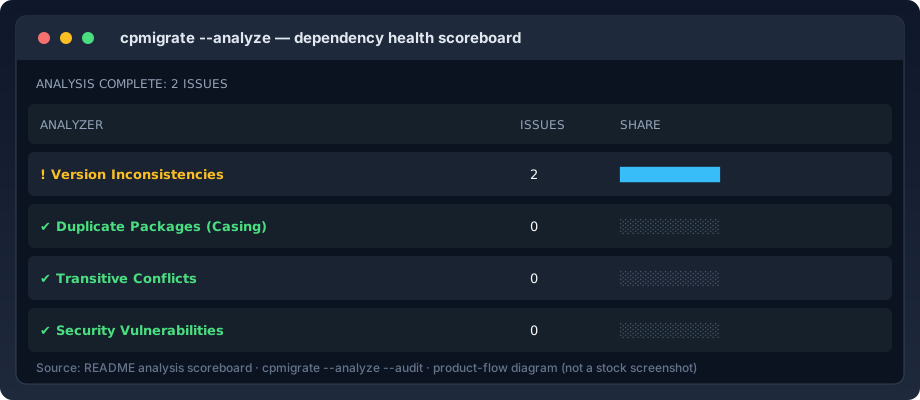
Dependency analysis scoreboard
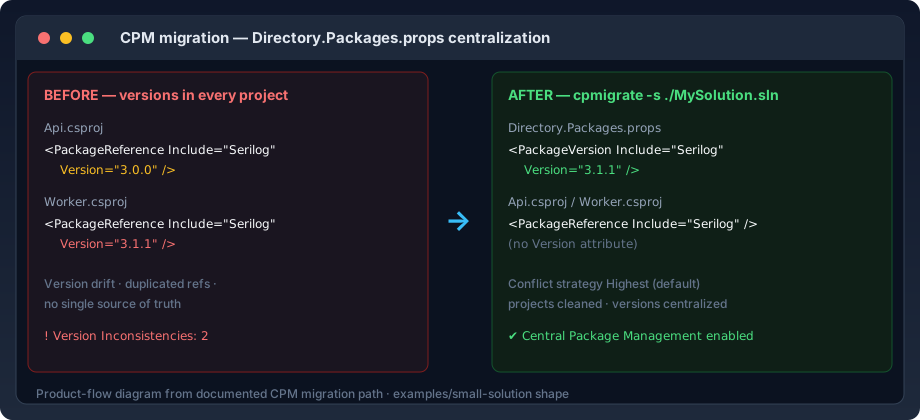
CPM migration before / after
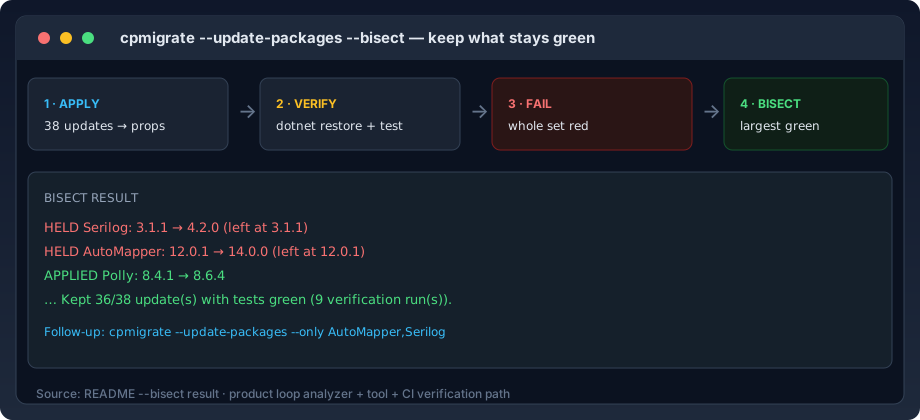
Safe package updates with --bisect
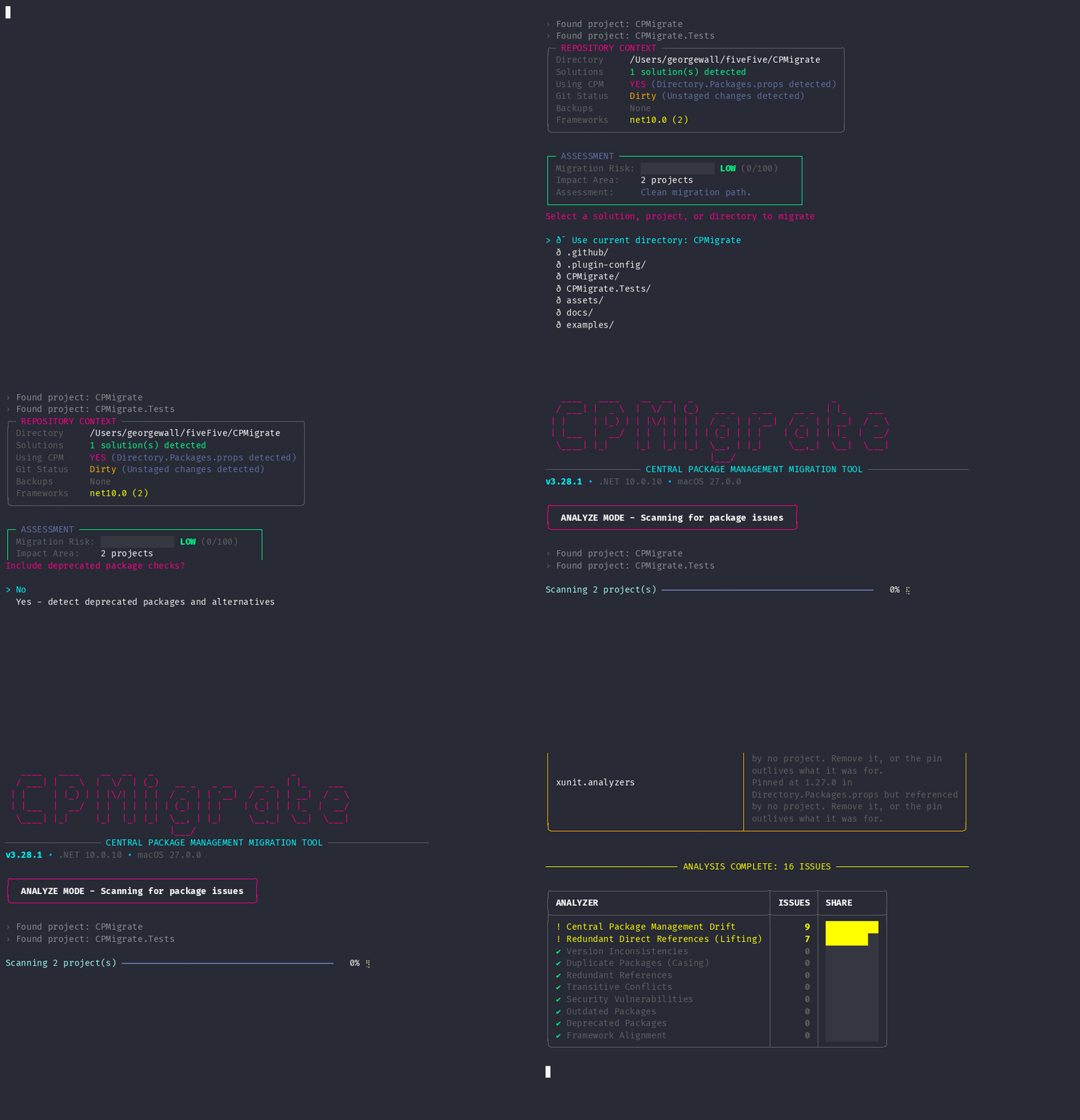
Terminal recordings (also absolute HTTPS for NuGet PackageReadmeFile):
30-second path
# 1) Scan for issues (CI-safe exit codes)
cpmigrate --analyze --audit --outdated --deprecated --output Json --quiet > analysis.json

# 2) Preview migration to Directory.Packages.props
cpmigrate -s ./MySolution.sln --dry-run

# 3) Migrate to Central Package Management (CPM)
cpmigrate -s ./MySolution.sln

# 4) Safely update packages with rollback protection
cpmigrate --update-packages --dry-run

# 5) Keep the largest green subset when something breaks tests
cpmigrate --update-packages --bisect
Interactive first run: cpmigrate launches Mission Control (wizard). Single project: cpmigrate --project ./src/Api/Api.csproj --dry-run.
Feature snapshot
| Surface | What you get |
|---|---|
| CPM migration | Generate Directory.Packages.props, clean Version attributes from projects, conflict strategies |
| Dependency analysis | 10 built-in analyzers + scoreboard; JSON, SARIF, and Markdown for CI |
| Auto-fix | Version, casing, redundant refs, transitive pin |
| Package updates | Latest versions + dotnet test + automatic rollback |
--bisect |
Largest green update subset; names held-back packages |
Directory.Build.props |
Unify repeated properties across projects |
| Batch / monorepo | Sequential or parallel multi-solution runs |
| Backup & rollback | On-disk backups for migration and update paths |
.sln + .slnx |
Classic solutions and Visual Studio 17.10+ .slnx |
Why use CPMigrate instead of doing it by hand?
| Approach | What you get | Where it breaks down |
|---|---|---|
| Manual CPM migration | Full control over Directory.Packages.props |
Slow, easy to miss references, hard to repeat |
| Ad hoc scripts | Team-specific automation | Brittle, weak rollback and analysis |
Raw dotnet package list |
Inventory and vulnerability data | No migration, fixers, or central props generation |
| CPMigrate | Migration, analysis, auto-fix, safe updates, batch, CI JSON | Purpose-built for this path |
Who this is for
- .NET solution owners migrating to
Directory.Packages.props - App teams modernizing NuGet package management without hand-editing every project
- Monorepo and multi-solution teams standardizing dependency policy
- CI/CD maintainers who need machine-readable dependency analysis and safe update workflows
Compatibility
- .NET SDK: 8.0+ (tool targets
net10.0withLatestMajorroll-forward) - Project types:
.csproj/.fsproj/.vbproj - Solutions:
.slnand.slnx - CPM: generates and consumes standard NuGet Central Package Management files
Table of Contents
- The problem
- What it catches
- Install
- See it work
- 30-second path
- Feature snapshot
- Compatibility
- Quick Start
- Features
- CLI Reference
- Exit Codes
- CI/CD Integration
- Examples & Benchmarks
- Release Cadence
- Telemetry (Opt-in)
- Community Growth
- Gallery
- Contributing
- License
Quick Start
Interactive Mode (Recommended for first-time users)
cpmigrate
Launches the Mission Control dashboard — a step-by-step wizard that guides you through migration, analysis, package updates, rollback, and more. The wizard adapts to your environment: when CPM is already enabled, it offers Update NuGet Packages as a quick action with prompts for transitive dependencies, pre-release versions, and dry-run mode.
Migrate a solution to CPM
cpmigrate -s ./MySolution.sln
Preview changes without modifying files
cpmigrate -s ./MySolution.sln --dry-run
Migrate a single project
cpmigrate --project ./src/Api/Api.csproj --dry-run
Analyze dependency health
cpmigrate --analyze
Update all packages to latest versions
cpmigrate --update-packages

# Include transitive dependencies
cpmigrate --update-packages --transitive
Use in CI from the first run
# JSON-only output for CI parsers
cpmigrate --analyze --audit --outdated --deprecated --output Json --quiet > analysis.json

# Safe preview before migration
cpmigrate -s ./MySolution.sln --dry-run --output Json --quiet > migration-preview.json
Use the dedicated CI guide for GitHub Actions snippets and machine-readable workflows:
https://georgepwall1991.github.io/CPMigrate/guides/ci-cd/
Features
CPM Migration
Scans your .sln or .slnx file, extracts all <PackageReference> entries from .csproj / .fsproj / .vbproj files, resolves version conflicts, and generates a centralized Directory.Packages.props.
# Standard migration
cpmigrate -s ./MySolution.sln

# Merge into an existing Directory.Packages.props
cpmigrate -s ./MySolution.sln --merge

# Fail if any version conflicts exist (strict mode)
cpmigrate -s ./MySolution.sln --conflict-strategy Fail

# Prompt for each conflict interactively
cpmigrate -s ./MySolution.sln --interactive-conflicts
Conflict resolution strategies:
| Strategy | Behavior |
|---|---|
Highest |
Use the highest version found across projects (default) |
Lowest |
Use the lowest version found |
Fail |
Exit with error if any package has conflicting versions |
Dependency Analysis
Run 7 built-in analyzers without modifying any files:
cpmigrate --analyze
| Analyzer | What it detects |
|---|---|
| Version Inconsistencies | Same package with different versions across projects |
| Duplicate Packages | Same package referenced with different casing (e.g., Newtonsoft.Json vs newtonsoft.json) |
| Redundant References | Same package referenced multiple times within a single project |
| Transitive Conflicts | Transitive dependencies with divergent versions across projects |
| Framework Alignment | Projects targeting different TargetFramework values |
| Redundant Direct References | Explicit references already provided transitively (lifting candidates) |
| Security Vulnerabilities | Known CVEs in direct and transitive dependencies (requires --audit) |
# Include transitive dependencies in analysis
cpmigrate --analyze --transitive

# Include security vulnerability scanning
cpmigrate --analyze --audit

# Full analysis with all checks
cpmigrate --analyze --transitive --audit

# Include outdated + deprecated checks
cpmigrate --analyze --outdated --deprecated
Every run ends with a scoreboard tallying each analyzer's findings, so a long scroll of individual tables resolves into one scannable summary:
────────────────────────── ANALYSIS COMPLETE: 2 ISSUES ──────────────────────────

╭─────────────────────────────────────────┬────────┬────────────╮
│ ANALYZER                                │ ISSUES │ SHARE      │
├─────────────────────────────────────────┼────────┼────────────┤
│ ! Version Inconsistencies               │      2 │ ██████████ │
│ ✔ Duplicate Packages (Casing)           │      0 │ ░░░░░░░░░░ │
│ ✔ Transitive Conflicts                  │      0 │ ░░░░░░░░░░ │
│ ✔ Security Vulnerabilities              │      0 │ ░░░░░░░░░░ │
╰─────────────────────────────────────────┴────────┴────────────╯
Auto-Fix
Automatically fix detected issues:
# Fix all auto-fixable issues
cpmigrate --analyze --fix

# Preview what fixes would be applied
cpmigrate --analyze --fix-dry-run
Available fixers:
| Fixer | What it fixes |
|---|---|
| Version Inconsistency Fixer | Standardizes package versions across projects using the configured conflict strategy |
| Duplicate Package Casing Fixer | Normalizes package name casing to the most common variant |
| Redundant Reference Fixer | Removes duplicate <PackageReference> entries within the same project |
| Transitive Conflict Pinner | Pins divergent transitive dependencies in Directory.Packages.props |
Package Updates with Test Verification
New in v3.0. Update all NuGet packages to their latest versions with automatic test verification and rollback. v3.2 adds full support in the interactive wizard — run cpmigrate -i and select "Update NuGet packages" from the maintenance menu.
# Preview available updates
cpmigrate --update-packages --dry-run

# Update packages, run tests, rollback on failure
cpmigrate --update-packages

# Include pre-release versions
cpmigrate --update-packages --include-prerelease

# Or use the interactive wizard (v3.2+)
cpmigrate -i
Transitive Dependency Pinning (v3.1)
New in v3.1. Add --transitive to also scan and pin transitive (indirect) dependencies:
# Preview direct + transitive updates
cpmigrate --update-packages --transitive --dry-run

# Update direct packages and pin transitive deps
cpmigrate --update-packages --transitive

# With pre-release versions
cpmigrate --update-packages --transitive --include-prerelease
When --transitive is enabled, CPMigrate:
- Scans all projects via
dotnet list package --include-transitive - Deduplicates across projects (picks the highest resolved version)
- Excludes transitive deps already managed as direct dependencies
- Queries NuGet for the latest version of each transitive dep
- Shows separate DIRECT UPDATES and TRANSITIVE UPDATES sections
- Pins accepted transitive updates as new
<PackageVersion>entries inDirectory.Packages.props
Per-project scan failures are logged and skipped gracefully. If all scans fail, the tool continues with direct-only updates.
How it works:
- Reads current versions from
Directory.Packages.props - Queries the NuGet API for latest versions (8 concurrent lookups)
- Optionally scans transitive dependencies (
--transitive) - Shows a table of available updates (separate sections for direct and transitive)
- For major version bumps, prompts you interactively: accept or skip
- Minor/patch updates are auto-accepted
- Creates a backup of
Directory.Packages.props - Applies version updates and transitive pins atomically
- Runs
dotnet restorethendotnet test - Tests pass — keeps updates, cleans up backup
- Tests fail — rolls back all changes (including transitive pins) automatically
Requires CPM to be enabled. If
Directory.Packages.propsdoesn't exist, runcpmigratefirst to migrate. Transitive scanning requiresdotnet restoreto have been run beforehand.
Bisecting Updates (v3.6)
New in v3.6. Step 11 above is all-or-nothing: one bad package in a set of 38 reverts the other 37 and tells you nothing about which one broke. --bisect instead applies the largest subset that keeps tests green and names the packages it held back.
# Keep what works, hold back what doesn't
cpmigrate --update-packages --bisect

# Bound the search, and probe against a fast slice of the suite
cpmigrate --update-packages --bisect --bisect-budget 24 --bisect-test-filter "Category=Unit"

# Follow up on the packages it named
cpmigrate --update-packages --only Serilog,AutoMapper
✔ 38 updates applied → tests FAILED
  38 update(s) failed together — narrowing...
  Holding back Serilog 3.1.1 → 4.2.0 (tests failed).

────────────────────────────── BISECT RESULT ──────────────────────────────

  HELD    Serilog: 3.1.1 → 4.2.0 (left at 3.1.1)
  HELD    AutoMapper: 12.0.1 → 14.0.0 (left at 12.0.1)
  APPLIED Polly: 8.4.1 → 8.6.4
  …

Kept 36/38 update(s) with tests green (9 verification run(s)).
  Investigate with: cpmigrate --update-packages --only AutoMapper,Serilog
How the search works:
- The whole set is verified first, so a healthy update run costs exactly one verification and pays no bisection overhead. Only a failure triggers the split.
- On failure the set is halved. A half that verifies clean is banked and becomes part of the baseline every later probe builds on; a half that fails is split again until it is a single package, which is then held back.
- Probing against the banked-good set — rather than testing each package in isolation — is what lets it resolve failures that need two packages together (a library plus its own updated dependency). A plain binary search assumes one independent culprit and gets these wrong.
- If nothing at all can be kept, CPMigrate verifies the zero-update baseline before blaming the packages, so an already-red test suite is reported as such.
Cost. Expect roughly 2·log₂(n) restore+test cycles for a single culprit — about 9–12 runs for a 40-package set. --bisect-budget (default 16) caps it. When the budget runs out, whatever is still unresolved is held back and the banked-good set is still applied, so an interrupted search delivers partial progress rather than nothing.
Exit codes. 0 when the tree ends green and at least one update was applied — check summary.packagesHeldBack in --output Json to see whether it was a clean sweep or a partial one. 7 (test failure) when nothing could be applied.
--bisectcannot be combined with--dry-run: the search has to observe real test runs.
Directory.Build.props Unification
Promote repeated properties and items from individual project files into a shared Directory.Build.props:
# Preview what would be unified
cpmigrate --unify-props --dry-run

# Apply unification
cpmigrate --unify-props

# Skip confirmation prompt
cpmigrate --unify-props --force
Identifies properties and items present in at least 60% of projects with the same value (e.g., TargetFramework, ImplicitUsings, Nullable, Authors) and migrates them to the root-level file. Individual project files are cleaned up automatically.
Batch Processing
Process multiple solutions in a monorepo:
# Sequential processing
cpmigrate --batch /path/to/repo

# Parallel processing (uses all CPU cores)
cpmigrate --batch /path/to/repo --batch-parallel

# Continue on failure
cpmigrate --batch /path/to/repo --batch-parallel --batch-continue
Recursively discovers .sln and .slnx files, excluding common non-project directories (node_modules, bin, obj, .git, etc.). Each solution gets an isolated backup directory to prevent collisions.
Backup & Rollback
Every migration creates a timestamped backup. Roll back at any time:
# Rollback to previous state
cpmigrate --rollback

# List all backups
cpmigrate --list-backups

# Prune old backups, keeping the last 3
cpmigrate --prune-backups --retention 3

# Delete all backups
cpmigrate --prune-all
Backups are stored in .cpmigrate_backup/ with a JSON manifest for reliable restoration. Use --add-gitignore to automatically add the backup directory to .gitignore.
Configuration File
Create a .cpmigrate.json in your repository root to set default options:
{
  "$schema": "https://raw.githubusercontent.com/georgepwall1991/CPMigrate/main/schemas/cpmigrate.schema.json",
  "ConflictStrategy": "Highest",
  "Backup": true,
  "BackupDir": ".",
  "AddGitignore": true,
  "MergeExisting": false,
  "OutputFormat": "Terminal",
  "Retention": {
    "Enabled": true,
    "MaxBackups": 5
  }
}
The config file is discovered by walking up from the selected solution/project path, or from the current directory when no path is provided. CLI arguments always take precedence over config file values.
CLI Reference
Migration & Core
| Option | Short | Default | Description |
|---|---|---|---|
--solution |
-s |
current directory | Path to .sln / .slnx file or directory |
--project |
-p |
Path to a specific project file, or a directory containing one project | |
--output-dir |
-o |
. |
Output directory for Directory.Packages.props |
--dry-run |
-d |
false |
Preview changes without modifying files |
--merge |
false |
Merge into existing Directory.Packages.props |
|
--conflict-strategy |
Highest |
Version conflict resolution: Highest, Lowest, Fail |
|
--interactive-conflicts |
false |
Prompt for each version conflict | |
--keep-attrs |
-k |
false |
Keep Version attributes in project files |
--interactive |
-i |
false |
Launch the interactive Mission Control wizard (migration, analysis, package updates, rollback, batch, backups) |
Analysis & Auto-Fix
| Option | Short | Default | Description |
|---|---|---|---|
--analyze |
-a |
false |
Run dependency health analysis |
--transitive |
false |
Include transitive dependencies | |
--audit |
false |
Include security vulnerability scanning | |
--outdated |
false |
Include outdated package checks | |
--deprecated |
false |
Include deprecated package checks | |
--fix |
false |
Apply auto-fixes (requires --analyze) |
|
--fix-dry-run |
false |
Preview auto-fixes without applying | |
--fail-on |
Info |
Lowest severity that fails the build: Info, Low, Moderate, High, Critical, or Never |
|
--max-parallelism |
processors (max 8) | Projects queried at once during --audit / --outdated / --deprecated |
|
--baseline |
Path to a file of accepted findings; they are reported but do not fail the build | ||
--write-baseline |
false |
Record current findings as the accepted baseline, then exit |
Gating on severity with --fail-on
By default any finding fails the build. That is unusable for a repository with existing debt: the
gate fires on every run, so it gets switched off — and the vulnerability you actually cared about
goes with it. --fail-on narrows the gate without narrowing the report.
# Fail only on High and Critical findings; everything else is still reported
cpmigrate --analyze --audit --outdated --fail-on High

# Report everything, gate on nothing (useful when SARIF upload is the signal)
cpmigrate --analyze --audit --output Sarif --output-file cpmigrate.sarif --fail-on Never
Findings below the threshold still appear in terminal, JSON, and SARIF output — only the exit code changes. Each rule's default severity is listed in the rule reference.
--fail-on cannot suppress exit 8 (IncompleteAnalysis). A severity threshold
says which findings matter; it does not make an unexamined project safe.
Adopting a gate on an existing codebase with --baseline
Severity is one axis; the other is which findings. A repository that already has debt cannot turn on a gate that fails on all of it, so record the current state once and gate on what is new:
# Once, on a green branch — writes .cpmigrate-baseline.json; commit it
cpmigrate --analyze --audit --outdated --write-baseline

# Every run after that: existing debt is reported, new debt fails
cpmigrate --analyze --audit --outdated --baseline .cpmigrate-baseline.json
--baseline needs an explicit path. To apply it to every run without repeating it, set it in
.cpmigrate.json (below).
Baselined findings stay in every report — terminal, JSON (suppressed: true), and SARIF (as a
suppressions entry with kind: "external"). The debt stays visible; it just stops blocking.
A finding is identified by its rule, package, and affected projects — deliberately not by the
versions in its description. A version inconsistency drifting from 13.0.1, 12.0.3 to
13.0.2, 12.0.3 is the same unresolved finding, so the suppression holds. Spreading to another
project is new information, so it does not.
When baseline entries stop matching anything — the findings were fixed — CPMigrate says so and suggests regenerating, which is what stops a baseline growing forever and quietly suppressing a finding that came back.
A baseline is never recorded from an incomplete scan: if a project fails to scan or an --audit
query fails, --write-baseline refuses and exits 8 rather than writing a file that permanently
accepts findings nobody looked for.
Set the path once for the team in .cpmigrate.json:
{ "baseline": ".cpmigrate-baseline.json", "failOn": "High" }
Set it once for the whole team in .cpmigrate.json:
{ "failOn": "High" }
The JSON payload reports the policy alongside the findings, so a consumer never has to re-derive it:
"summary": {
  "issuesFound": 12,
  "failOnSeverity": "High",
  "issuesAtOrAboveThreshold": 0,
  "highestSeverity": "Moderate",
  "scanFailures": 0,
  "deepScanFailures": 0
}
Package Updates (v3.0+)
| Option | Default | Description |
|---|---|---|
--update-packages |
false |
Update all packages to latest, run tests, rollback on failure |
--transitive |
false |
Also scan and pin transitive dependencies (v3.1) |
--include-prerelease |
false |
Include pre-release versions when updating |
--bisect |
false |
On failure, keep the largest subset that stays green instead of reverting everything (v3.6) |
--bisect-budget |
16 |
Max restore+test cycles a bisection may spend (v3.6) |
--bisect-test-filter |
dotnet test --filter expression used for each bisection probe (v3.6) |
|
--only |
Comma-separated package IDs to restrict the update to (v3.6) |
Modernization
| Option | Default | Description |
|---|---|---|
--unify-props |
false |
Migrate common properties to Directory.Build.props |
--force |
false |
Skip confirmation prompts |
Batch Processing
| Option | Default | Description |
|---|---|---|
--batch |
Directory to scan recursively for solutions | |
--batch-parallel |
false |
Process solutions in parallel |
--batch-continue |
false |
Continue even if a solution fails |
Backup & Rollback
| Option | Short | Default | Description |
|---|---|---|---|
--rollback |
-r |
false |
Restore from most recent backup |
--no-backup |
-n |
false |
Disable backup creation |
--backup-dir |
. |
Backup directory location | |
--list-backups |
false |
List all available backups | |
--prune-backups |
false |
Delete old backups based on --retention |
|
--prune-all |
false |
Delete all backups | |
--retention |
5 |
Number of backups to keep when pruning | |
--add-gitignore |
false |
Add backup directory to .gitignore |
|
--gitignore-dir |
. |
Directory to create .gitignore in, when there is not one already |
Output & Logging
| Option | Short | Default | Description |
|---|---|---|---|
--output |
Terminal |
Output format: Terminal, Json, Sarif, or Markdown (the last two require --analyze) |
|
--output-file |
Write Json, Sarif, or Markdown output to a file |
||
--quiet |
-q |
false |
Suppress non-essential output |
--verbose |
-v |
false |
Enable diagnostic logging to cpmigrate.log |
Explain a rule
| Option | Description |
|---|---|
--explain <RuleId> |
Print what a rule means, why it matters, and how to resolve it |
--explain all |
List every rule with a one-line summary |
A rule ID in a build log or a SARIF annotation is exactly where someone needs to know what the rule
means — and exactly where they will not go looking for a docs site. The same IDs appear as
issueCode in JSON and ruleId in SARIF, so whatever a report names can be pasted straight back:
cpmigrate --explain InlineVersionUnderCpm
A near miss suggests the real rule, and an unrecognised ID exits non-zero so a typo in CI is visible. Full reference: docs/rules.md.
Shell Completions
| Option | Default | Description |
|---|---|---|
--completions |
Print a completion script and exit: Bash, Zsh, Fish, or PowerShell |
Generated from the option list rather than hand-written, so it cannot drift out of step with the
CLI — a completion script that suggests flags which no longer exist is worse than none at all.
Enum-valued options complete their values (--output offers Terminal, Json, Sarif, Markdown),
and path options complete filenames.
# bash
cpmigrate --completions bash > /usr/local/etc/bash_completion.d/cpmigrate

# zsh — into any directory on $fpath
cpmigrate --completions zsh > "${fpath[1]}/_cpmigrate"

# fish
cpmigrate --completions fish > ~/.config/fish/completions/cpmigrate.fish

# PowerShell
cpmigrate --completions powershell >> $PROFILE
Self-Update
| Option | Default | Description |
|---|---|---|
--update |
false |
Check for and install the latest version of CPMigrate |
Exit Codes
| Code | Name | Meaning |
|---|---|---|
0 |
Success | Operation completed successfully |
1 |
ValidationError | Invalid command-line options |
2 |
FileOperationError | File I/O or permission failure |
3 |
VersionConflict | Unresolvable version conflict (with --conflict-strategy Fail) |
4 |
NoProjectsFound | No .csproj / .fsproj / .vbproj files discovered |
5 |
AnalysisIssuesFound | Analysis detected issues (useful for CI gates) |
6 |
UnexpectedError | Unhandled exception |
7 |
TestFailure | Tests failed after package update (rollback performed). With --bisect, returned only when no update could be kept |
8 |
IncompleteAnalysis | A requested scan did not finish, so the findings are incomplete — nothing was necessarily found wrong, but part of the solution went unexamined |
On 8 (IncompleteAnalysis): if a project fails to scan, or a --audit / --outdated /
--deprecated query fails, the run produces no findings for the part it could not read. Before
3.7.0 that exited 0, which a CI gate reads as "clean" — the one failure mode a security gate
exists to prevent. Treat 8 as "re-run or investigate", not as "no issues".
CI/CD Integration
Strict JSON Contract Mode
Use --output Json --quiet to guarantee JSON-only stdout, including when CPMigrate discovers a .cpmigrate.json file. That makes it safe for CI parsing without stripping banners, config notices, or other preamble.
# analyze
cpmigrate --analyze --audit --outdated --deprecated --output Json --quiet > analyze.json

# migrate
cpmigrate -s ./MySolution.sln --dry-run --output Json --quiet > migrate.json

# rollback
cpmigrate --rollback --backup-dir . --output Json --quiet > rollback.json

# update-packages
cpmigrate --update-packages --dry-run --output Json --quiet > update-packages.json
Non-Interactive Terminals
CPMigrate detects when stdout is redirected — a CI runner, a pipe, > log.txt — and never
attempts a prompt it cannot service:
- Post-migration verification (
dotnet restore) is skipped rather than prompted for. It is also skipped after--dry-run, since nothing was written to verify. --rollbackdeclines instead of prompting, and tells you to re-run with--forceto roll back unattended.- Unicode status glyphs (
✔ ✖ ➜ █) fall back to ASCII equivalents when the terminal reports no Unicode support, so build logs stay readable instead of filling with replacement characters.
No Sub-Commands
CPMigrate is flag-driven. There is no cpmigrate analyze verb — the analysis command is
cpmigrate --analyze. A leading bare word is rejected rather than ignored, because a discarded
verb would otherwise fall through to the default action and start a real migration:
✖ Unrecognized argument 'analyze'. CPMigrate takes flags, not sub-commands.
› Did you mean: cpmigrate --analyze -s ./MySolution.sln
SARIF for GitHub code scanning
--output Sarif emits a SARIF 2.1.0
log, so findings appear as annotations on the pull request diff instead of buried in build logs.
Each result points at the project file and the line declaring the offending PackageReference,
carries the rule's description and a link to the rule reference, and includes a
stable fingerprint so code scanning tracks a finding across runs rather than reopening it.
cpmigrate --analyze --audit --outdated --deprecated \
  --output Sarif --output-file cpmigrate.sarif --quiet
SARIF describes analyzer findings, so --output Sarif requires --analyze. Severities map to SARIF
levels as Critical/High → error, Moderate → warning, Low/Info → note.
Markdown for a job summary or PR comment
SARIF only surfaces findings that map to a line in the diff under review, and a dependency problem
is usually about the solution as a whole — so it never appears on the diff, and nobody goes digging
in build logs for it. --output Markdown puts the report where a reviewer will actually see it:
cpmigrate --analyze --audit --outdated --output Markdown --quiet >> "$GITHUB_STEP_SUMMARY"
The report leads with the verdict — did anything reach the --fail-on threshold — then scan totals,
a severity breakdown, and a table of findings linking each one to its rule.
Baselined findings are marked. An incomplete scan gets a prominent warning, because "no findings"
from a scan that did not finish reads exactly like a clean result. Long finding lists collapse behind
a <details> disclosure so they do not bury the rest of the summary.
To post it as a PR comment instead:
- name: Analyze dependencies
  id: analyze
  run: |
    set +e
    cpmigrate --analyze --audit --output Markdown --output-file report.md --quiet
    echo "exit_code=$?" >> "$GITHUB_OUTPUT"

- name: Comment on the PR
  if: github.event_name == 'pull_request'
  run: gh pr comment "${{ github.event.number }}" --body-file report.md
  env:
    GH_TOKEN: ${{ github.token }}
GitHub Actions Example
- name: Install CPMigrate
  run: dotnet tool install --global CPMigrate

- name: Check dependency health
  run: cpmigrate --analyze --audit --output Json --output-file analysis.json --quiet

- name: Fail on issues
  run: |
    EXIT_CODE=$(cpmigrate --analyze --audit --quiet; echo $?)
    if [ $EXIT_CODE -eq 5 ]; then
      echo "::error::Dependency issues detected"
      exit 1
    fi
Or upload SARIF and let code scanning annotate the diff. Capture the exit code rather than using
continue-on-error: that would swallow every failure, including exit 8
(IncompleteAnalysis) — leaving the job green on exactly the unexamined-dependency
case the upload is meant to catch. Exit 5 is expected here, because code scanning is the gate:
- name: Install CPMigrate
  run: dotnet tool install --global CPMigrate

- name: Analyze dependencies
  id: analyze
  run: |
    set +e
    cpmigrate --analyze --audit --outdated --deprecated \
      --output Sarif --output-file cpmigrate.sarif --quiet
    echo "exit_code=$?" >> "$GITHUB_OUTPUT"

- name: Upload SARIF
  if: always() && hashFiles('cpmigrate.sarif') != ''
  uses: github/codeql-action/upload-sarif@v3
  with:
    sarif_file: cpmigrate.sarif

- name: Require a completed scan
  run: |
    code="${{ steps.analyze.outputs.exit_code }}"
    # 0 = clean. 5 = issues found, already annotated on the diff by code scanning.
    # Anything else (8 = incomplete scan, 1/2/6 = errors) means the results cannot be trusted.
    case "$code" in
      0|5) ;;
      *) echo "::error::cpmigrate exited $code - the analysis did not complete"; exit 1 ;;
    esac
JSON Output
Use --output Json to produce machine-readable output for CI/CD pipelines:
cpmigrate --analyze --output Json --output-file report.json
The payload has a published schema at
schemas/cpmigrate-output.schema.json, so a parser can be
validated rather than guessed at, and editors will complete a recorded fixture. Key off
outputSchemaVersion rather than the tool version — additive changes bump its minor, and the one
field whose meaning has ever changed is called out in the CHANGELOG.
Two things worth knowing before writing a parser:
success: truedoes not mean "no findings". Findings below the--fail-onthreshold, and findings a baseline accepted, both leave it true. Checksummary.issuesFoundfor whether anything was reported at all, andsummary.issuesAtOrAboveThresholdfor what the exit code reflects.- Absent fields are meaningful.
summaryomits counters irrelevant to the command that ran, so a missingissuesBaselinedmeans no baseline was used — not zero suppressions.
Examples & Benchmarks
- Starter example:
examples/small-solution/ - Monorepo example:
examples/monorepo/ - Benchmark table:
docs/benchmarks.md
These sample repositories are designed for onboarding, CI templates, and reproducible before/after conversion demos.
Release Cadence
- Stable releases: weekly, versioned and changeloged
- Release candidates (RC): published for fast feedback before stable promotion
- Change log source of truth:
CHANGELOG.md - Policy details:
docs/release-cadence.md
Telemetry (Opt-in)
CPMigrate supports privacy-first telemetry that is disabled by default.
- Enable by setting
CPMIGRATE_TELEMETRY_OPT_IN=true - Captures only command-level metrics (operation, duration, exit code category, high-level flags)
- Captures no project paths, package names, file contents, or source code
- Stores local events at
~/.cpmigrate/telemetry/events.ndjson
Community Growth
- Enable GitHub Discussions and pin:
Start here(first-run flow + CI JSON mode)Success stories(before/after migration outcomes)
- Use Discussions as the primary intake for usage feedback and roadmap voting.
Gallery
Migration Pipeline
The pipeline renders as a connected stepper — completed stages and the rails behind them light up, so progress is legible at a glance:
✔ DISCOVERY ─── ✔ ANALYSIS ─── ▶ BACKUP ─── ○ MIGRATION ─── ○ VERIFICATION
Risk Assessment
Before anything is written, CPMigrate scores the migration and shows the reasoning:
┌─ ASSESSMENT ──────────────────────────────────────────────────────────┐
│ Migration Risk: ████████░░░░░░ HIGH (58/100)                          │
│ Impact Area:    12 projects • 7 conflicting package(s)                │
│ Assessment:     Significant version conflicts. Review recommended.    │
└───────────────────────────────────────────────────────────────────────┘
┌─ ASSESSMENT ──────────────────────────────────┐
│ Migration Risk: ░░░░░░░░░░░░░░ LOW (0/100)    │
│ Impact Area:    12 projects                   │
│ Assessment:     Clean migration path.         │
└───────────────────────────────────────────────┘
Conflict Resolution
Version conflict tables bold the winning version and dim the ones being dropped, so the resolution reads without comparing strings:
               VERSION CONFLICTS
╭─────────────────┬────────────────┬──────────╮
│ PACKAGE         │ VERSIONS       │ RESOLVED │
├─────────────────┼────────────────┼──────────┤
│ Newtonsoft.Json │ 13.0.3, 13.0.1 │ ➜ 13.0.3 │
│ Serilog         │ 3.1.1, 3.0.0   │ ➜ 3.1.1  │
╰─────────────────┴────────────────┴──────────╯
Mission Control Dashboard
The interactive wizard assessing migration risk and guiding you through each step.
Risk Analysis & Dry Run
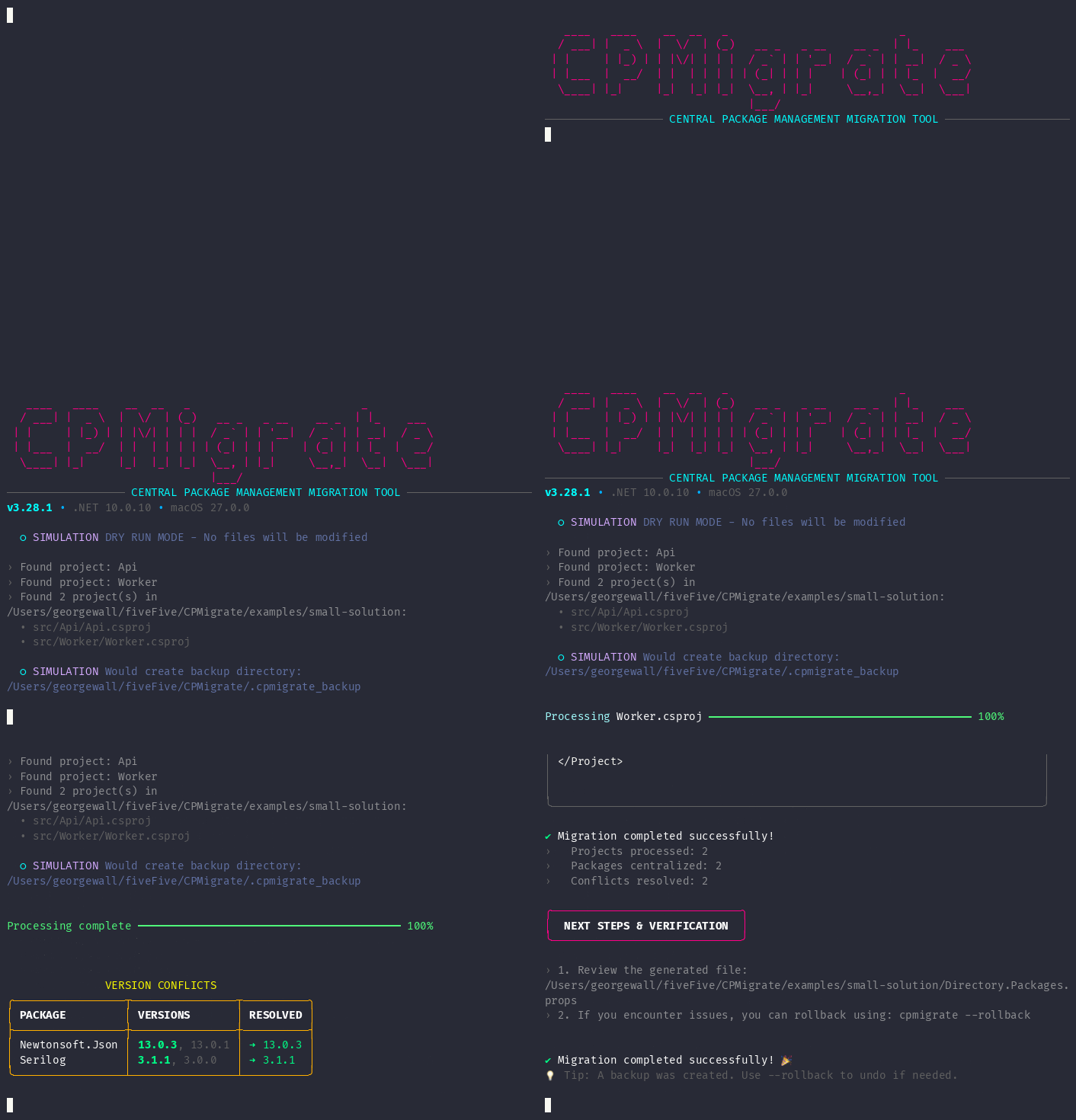 Previewing changes safely before committing.
Security & Package Analysis
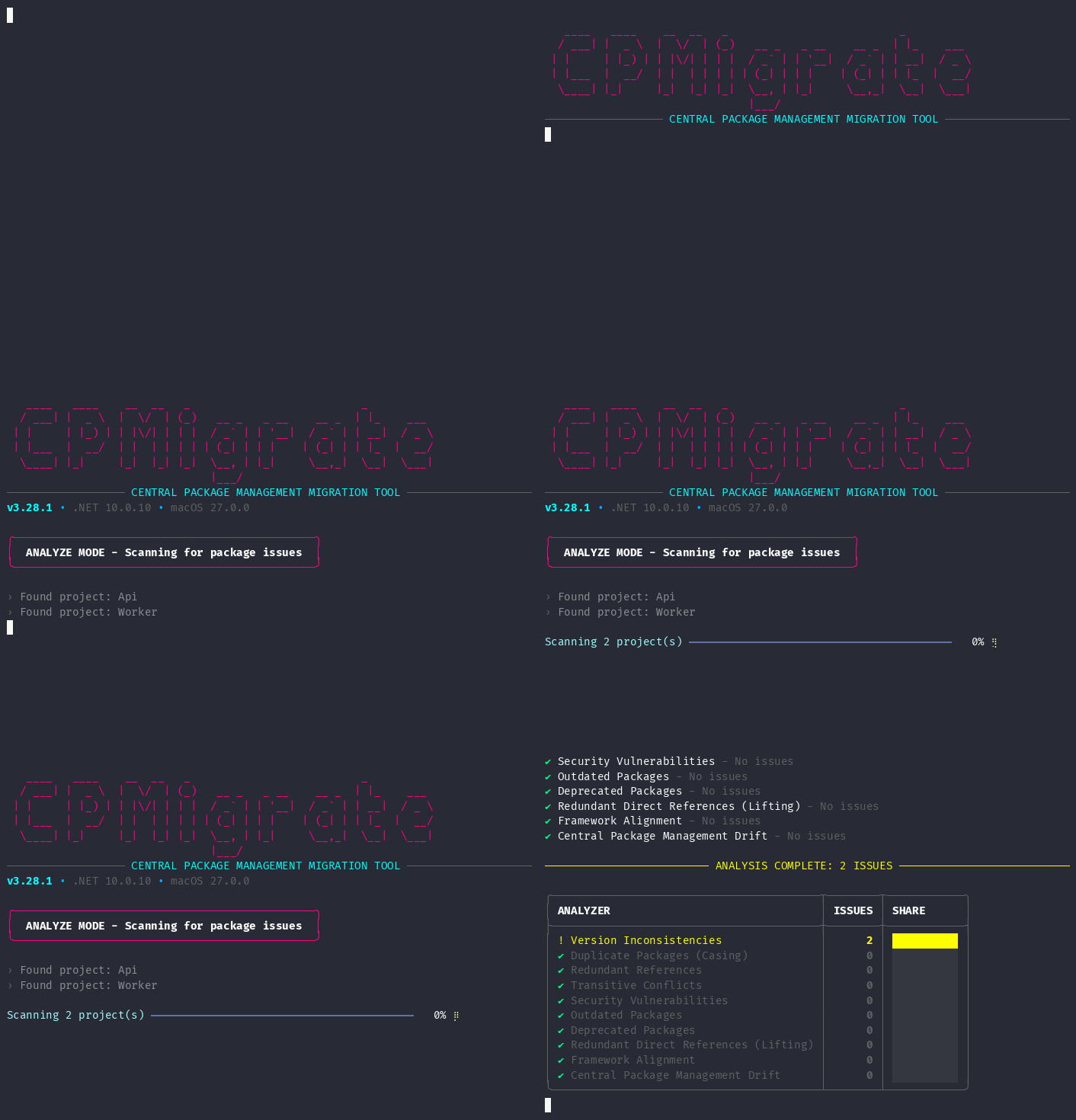 Scanning for vulnerabilities and redundant dependencies.
Contributing
Contributions are welcome. To get started:
- Fork the repository
- Create a feature branch (
git checkout -b feature/my-feature) - Write tests for your changes
- Ensure all 571 tests pass (
dotnet test) - Open a Pull Request
License
Distributed under the MIT License. See LICENSE for more information.
Author
George Wall — @georgepwall1991
| Product | Versions Compatible and additional computed target framework versions. |
|---|---|
| .NET | net10.0 is compatible. net10.0-android was computed. net10.0-browser was computed. net10.0-ios was computed. net10.0-maccatalyst was computed. net10.0-macos was computed. net10.0-tvos was computed. net10.0-windows was computed. |
This package has no dependencies.
| Version | Downloads | Last Updated |
|---|---|---|
| 3.28.1 | 0 | 7/30/2026 |
| 3.28.0 | 0 | 7/30/2026 |
| 3.27.0 | 0 | 7/30/2026 |
| 3.26.0 | 0 | 7/30/2026 |
| 3.25.1 | 0 | 7/30/2026 |
| 3.25.0 | 20 | 7/30/2026 |
| 3.24.0 | 19 | 7/30/2026 |
| 3.23.0 | 29 | 7/30/2026 |
| 3.22.0 | 24 | 7/30/2026 |
| 3.21.0 | 32 | 7/30/2026 |
| 3.20.0 | 40 | 7/30/2026 |
| 3.19.0 | 34 | 7/30/2026 |
| 3.18.0 | 32 | 7/30/2026 |
| 3.17.1 | 27 | 7/30/2026 |
| 3.17.0 | 30 | 7/30/2026 |
| 3.16.0 | 28 | 7/30/2026 |
| 3.15.0 | 32 | 7/30/2026 |
| 3.14.0 | 34 | 7/30/2026 |
| 3.13.0 | 34 | 7/30/2026 |
| 3.12.0 | 37 | 7/29/2026 |
Closes a security-relevant race in --audit, --outdated and --deprecated that has been present since 3.15.0. Those queries shell out to `dotnet package list`, which restores — so two projects sharing a project.assets.json corrupt each other's results. Demonstrated with two projects in one directory, one pinned to a Newtonsoft.Json version with a known high-severity advisory and one to a clean version: queried concurrently, the clean project was reported carrying the vulnerable version. It runs the other way just as easily, which is a genuinely vulnerable project reported clean, with nothing in the output to say so. Each deep scan now reuses the isolated directory its project's resolved scan proved usable, and where that scan escaped, it runs under the exclusive restore lock instead. Previously in 3.27.0: Every dependency is now current — MSBuild 18.8.2, Buildalyzer 9, Spectre.Console 0.57.2, SonarAnalyzer 10.31, coverlet 10 — with nothing outdated left. This also corrects the record: 3.24.0 reported that Microsoft.Build 18.8.2 broke 20 tests. It does not, and it did not. That run took 14 minutes against a normal 2 and the machine ran out of disk shortly afterwards; the bisect that produced the claim never tested the MSBuild packages on their own. Verified now on both this code and the pre-3.26.0 code: clean either way. Previously in 3.26.0: Analysis is about four times faster on a large solution: 60 projects went from 200s to 50s, with byte-identical findings. Resolving packages shells out to `dotnet package list` once per project — a separate process that spends most of its time waiting — and those now run concurrently. The reason it could not before is that `dotnet package list` restores, and two projects sharing an assets file cannot be queried at once: the loser reports the other project's packages, so two projects with different versions report the same one and the inconsistency disappears with a clean exit code. Each invocation now gets its own MSBuild intermediate directory, which makes that collision impossible rather than something to detect — the detection is not possible here, because where the assets file goes depends on MSBuild evaluation that this phase must not perform. Reading project files stays serial, deliberately: MSBuild's object model is not thread-safe. Previously in 3.25.1: Refreshes the dependencies bundled into the tool — Serilog 4.4.0, NuGet.Versioning 7.6.0, Microsoft.Extensions.Logging 10.0.10 — which were updated on main after 3.25.0 was tagged. No behaviour change: this is a PackAsTool package, so those assemblies ship inside it rather than being restored by consumers, and 3.25.0 was still carrying the older ones. Previously in 3.25.0: Holds the documentation to the tool. A flag that exists and is undocumented is invisible; one that is documented and no longer exists is worse, because it gets written into a CI script and discovered from an exit code. Neither shows up in a build, a test run, or a review of the code that changed — the docs are a different file and nothing was checking them. DocumentationDriftTests now asserts, by reflection, that every option appears in the README reference and every documented option still exists, that every exit code is in the table under its own name, and that every analysis rule has a published page. One option had already slipped (--gitignore-dir), which is the argument for asserting it rather than remembering. Previously in 3.24.0: Adds ScanWorkTests: the properties any change to the analysis scan's scheduling has to hold, rather than a duration — findings independent of --max-parallelism, shared-directory and redirected-output layouts still reporting their findings, and the same solution producing the same report twice. Also fixes a --fix regression from 3.23.0 where a framework-conditional pin read as an ordinary one and every other project was unified to it. A concurrent package-resolution change measured at two to four times faster was written and deliberately not shipped: whether two projects share a project.assets.json depends on full MSBuild evaluation, which that phase cannot do, and eight review rounds each found another route to a shared file. A scan that silently reports fewer findings is worse than a slow one. Previously in 3.23.0: Fixes --fix reporting "No changes were needed" when it could not change anything. Both fixers that edit project XML swallowed every exception and returned null, which the caller could only read as "nothing to change" — so on a read-only, locked, or malformed project file the run printed that reassuring line directly above "1 issue(s) could not be fixed automatically", two statements contradicting each other, and threw away the actual cause. The exit code was already right, because the post-fix rescan gates on the surviving finding; everything a human reads was wrong. Failures now carry their reason and name the file, one unreadable file still does not stop the others, and "No changes were needed" is printed only when that is true. Previously in 3.22.0: Closes the last four exemptions in the end-to-end rule guard, so every analysis rule is now proven against real data rather than taken on trust. The vulnerability, outdated, deprecated, and transitive rules were exempted as needing a live NuGet feed — true of the query, but not of the parsing and reporting after it, which is exactly where the 3.20.0 defect lived. They are now driven from JSON captured from real `dotnet package list` runs, which immediately found that a --transitive scan invented a duplicate-reference finding for any package present both directly and transitively. Previously in 3.21.0: Fixes RedundantReference, which could not fire, and its fixer, which could not fix. The rule reads package references from `dotnet package list` — the *resolved* graph — and resolution collapses two PackageReference items with the same Include into one, so by the time a duplicate reached the analyzer there was only ever one of it. Rules about what a project file says now read the references as declared. The fixer separately resolved projects by file name while findings have identified them by path since 3.10.0, so it matched nothing and returned "no fix needed": the run printed "No changes were needed" over an unrepaired finding. Conditional declarations are now respected by every rule and fixer: declaring a package once per target framework behind a Condition is how multi-targeting is written, and treating it as a duplicate or an inconsistency had --fix delete or overwrite the pin another framework depended on. The rule also now fires under central package management, where references carry no version at all. All found by a new end-to-end guard that drives the real CLI against real files and asserts every rule can actually fire — because the analyzer unit tests all passed throughout, proving the logic while nothing checked that the pipeline in front of it delivers the shape the logic expects. Previously in 3.20.0: Fixes the RedundantDirectReference analyzer, which had never reported anything. It reads the resolved dependency graph out of project.assets.json, but composed its lookup key from the version in project.frameworks.<tf>.dependencies — which NuGet writes as a range, "[7.0.0, )" — while the targets section is keyed by the resolved version, "Serilog/7.0.0". The key matched nothing on any real project, so the traversal found no dependencies and the analyzer reported a clean result instead of a broken lookup. Its tests passed because their fixtures used a bare version that restore never writes. Lookup is now by package name against the resolved graph, since restore settles on one version per package per framework and no version needs reconstructing. Two further conditions the corrected traversal needed, both found in cross-review: a reference that pins *higher* than anything else requires is not redundant, because removing it downgrades the package — the contract always said "at the same or higher version" and a reachability-only check dropped that; and a reference redundant under only some target frameworks is not reported, since removing it breaks the framework where it was independently required. Previously in 3.19.0: Directory.Packages.props keeps its shape across runs. A merge used to write new pins as <PackageVersion Include="X"><Version>1.0.0</Version></PackageVersion> while every entry around them used Version="1.0.0" — one file, two styles, and a three-line diff for a one-line addition. It also inserted new entries between a comment and the pin that comment documents, silently reattaching a team's "pinned because 2.x drops netstandard2.0" note to a different package, which is worse than losing it because the file still reads as correct. New pins now match whichever style the file already uses, a file that was ordered stays ordered, one that was not is left as its author arranged it, and where a comment occupies the sorted position the new entry goes one slot later rather than taking the explanation with it. Ordering is also no longer culture-sensitive. Previously in 3.18.0: Fixes the interactive wizard silently answering its own questions. Every prompt used to work out what an answer meant by reading its label back — StartsWith("Yes"), an exact match against the display string, or slicing an emoji prefix off a directory name — and every one of them had a quiet wrong answer behind it: an answer that matched nothing fell through to a default, so a reworded option flipped to its opposite and an unrecognised mission started a migration nobody asked for. Answers now carry their values, and an answer that was not offered is an error. Also fixes a real gap this was hiding: a repository with Directory.Packages.props at the top and projects under src/ — the ordinary shape of a migrated solution, and exactly what --analyze is pointed at — could not be selected in the browser at all. Previously in 3.17.1: Internal: CommandRouter dispatch is now an ordered table rather than an if/else chain. Behaviour-preserving, but it makes precedence explicit — which mode wins when several flags are present was previously decided by the order statements happened to appear in, and is now a readable list with tests asserting it. Previously in 3.17.0: publishes a JSON Schema for the --output Json payload at schemas/cpmigrate-output.schema.json. The contract has been versioned since 1.0.0 but never described, so consumers had to infer the shape from examples — and infer it wrong at the edges, which is where the fields that matter live: success: true does not mean "no findings" when they were below the --fail-on threshold or accepted by a baseline, and an absent summary counter means the command did not produce it rather than producing zero. Guarded against drift by reflection rather than a new dependency, so a field added without updating the schema fails the build. Previously in 3.16.0: adds --explain <RuleId>: rule documentation from the same terminal that produced the finding. A rule ID in a build log is the moment someone needs to know what it means and the moment they are least likely to go looking for a docs site. The same IDs appear as issueCode in JSON and ruleId in SARIF, so a report can be pasted straight back. --explain all lists every rule; a near miss suggests the real one; an unrecognised ID exits non-zero so a CI typo is visible. Previously in 3.15.0: --audit, --outdated, and --deprecated now query projects concurrently. Each shells out to 'dotnet package list' per project and waits on the network, so the scan scaled linearly with solution size for no reason: 10 projects with --outdated went from 12s to 6s. Bounded by --max-parallelism (default: processor count, capped at 8). Reading package references stays serial on purpose — that pass goes through MSBuild's object model, whose static caches are not thread-safe, and running it concurrently made projects report each other's versions and silently erased version-inconsistency findings. Results merge in project order, so a report is identical run to run. Previously in 3.14.0: fixes a failed NuGet version lookup being reported as "up to date". The lookup returned null both for "this package is current" and "the request failed", so one 503 or timeout during --update-packages silently dropped that package and the run still finished with "Everything up to date!" — on a slow connection a large solution could skip most of its updates and say nothing. Transient failures are now retried with exponential backoff and jitter, honouring Retry-After up to a cap; 404 and malformed bodies are treated as definitive; and whatever still fails is named rather than being counted as current. Lookups are also cached per run, so a package referenced from thirty projects costs one request instead of thirty. Previously in 3.13.0: adds --completions for bash, zsh, fish, and PowerShell. With 45 options, remembering which take a value — and that it is Sarif rather than SARIF — is not a reasonable expectation. Generated from the option metadata rather than hand-written, because a stale completion list is worse than none: it suggests flags that no longer exist. Enum options complete their values, path options complete filenames, and zsh shows help text inline. Previously in 3.12.0: adds four rules that catch a solution drifting back off central package management. Migrating is a one-off event; staying migrated is not — someone adds a package with an inline Version and the solution is quietly half-centralized, with NuGet saying nothing because the inline version simply wins. InlineVersionUnderCpm (an inline pin overriding the central one), MissingPackageVersion (no version anywhere; restore fails), OrphanedPackageVersion (a central pin nothing references), and CpmNotEnabled (a props file with central management switched off, so every entry is inert). Gated on data rather than a flag: nothing is reported unless the solution has a Directory.Packages.props. Previously in 3.11.0: adds --output Markdown: a report for a CI job summary or PR comment, because neither existing format reaches a human when they need it — JSON is for parsers and SARIF only surfaces findings that map to a line in the diff, which a solution-wide dependency problem never does. Leads with the verdict (did anything reach the --fail-on threshold), then scan totals, a severity breakdown, and a findings table linking each rule to its docs. Incomplete scans get a prominent warning, baselined findings are marked, long lists collapse, and table cells are escaped. Previously in 3.10.0: findings identify projects by their path relative to the scan root (src/App/App.csproj) rather than by file name. A file name is not an identifier — two projects can share one — which meant a baseline entry accepting debt in one project could silently suppress a new finding in another, and SARIF had to guess which same-named file to annotate. Action required: regenerate baselines, the fingerprint scheme is now v2 and a v1 file is rejected with an explicit instruction. JSON schema 1.3.0: analysisIssues[].affectedProjects holds relative paths. Previously in 3.9.0: adds --baseline and --write-baseline: adopt a CI gate on a codebase that already has debt. Record the current findings once, commit the file, and every run after that fails only on findings the baseline does not contain. Baselined findings stay in every report — terminal, JSON (suppressed: true), and SARIF (as a suppressions entry) — so the debt stays visible without blocking. A finding is identified by its rule, package, and affected projects rather than by the versions in its description, so version drift does not unsuppress accepted debt while spreading to a new project does. Stale entries are reported so a baseline cannot grow forever. Previously in 3.8.0: --fail-on <severity>: gate CI on the findings that matter instead of on all of them. Every finding used to fail the build, which makes the gate unusable for a repository with existing debt. --fail-on High narrows the gate without narrowing the report — findings below the threshold still appear in terminal, JSON, and SARIF output, and only the exit code changes. Accepts Info (default), Low, Moderate, High, Critical, and Never for report-without-gating; settable team-wide as "failOn" in .cpmigrate.json. Cannot suppress exit 8 (IncompleteAnalysis). JSON schema 1.2.0 adds summary.failOnSeverity, issuesAtOrAboveThreshold, highestSeverity, scanFailures, and deepScanFailures (all additive). Also fixes the published config schema, which was missing Sarif from outputFormat. Previously in 3.7.0: --output Sarif: cpmigrate --analyze now emits a SARIF 2.1.0 log for GitHub code scanning, so dependency findings annotate the pull request diff. Results point at the exact PackageReference line, carry full rule metadata with links to the new docs/rules.md reference, and include stable fingerprints so findings are tracked across runs rather than reopened. Tool failures emit an unsuccessful SARIF invocation, so an upload step never breaks on a malformed file. --output-file now accepts Sarif as well as Json. No analyzer severity changes.