CleanCodeJN.GenericApis
6.5.4
dotnet add package CleanCodeJN.GenericApis --version 6.5.4
NuGet\Install-Package CleanCodeJN.GenericApis -Version 6.5.4
<PackageReference Include="CleanCodeJN.GenericApis" Version="6.5.4" />
<PackageVersion Include="CleanCodeJN.GenericApis" Version="6.5.4" />
<PackageReference Include="CleanCodeJN.GenericApis" />
paket add CleanCodeJN.GenericApis --version 6.5.4
#r "nuget: CleanCodeJN.GenericApis, 6.5.4"
#:package CleanCodeJN.GenericApis@6.5.4
#addin nuget:?package=CleanCodeJN.GenericApis&version=6.5.4
#tool nuget:?package=CleanCodeJN.GenericApis&version=6.5.4
🚀 Generic Web APIs – Fast, Clean, Powerful
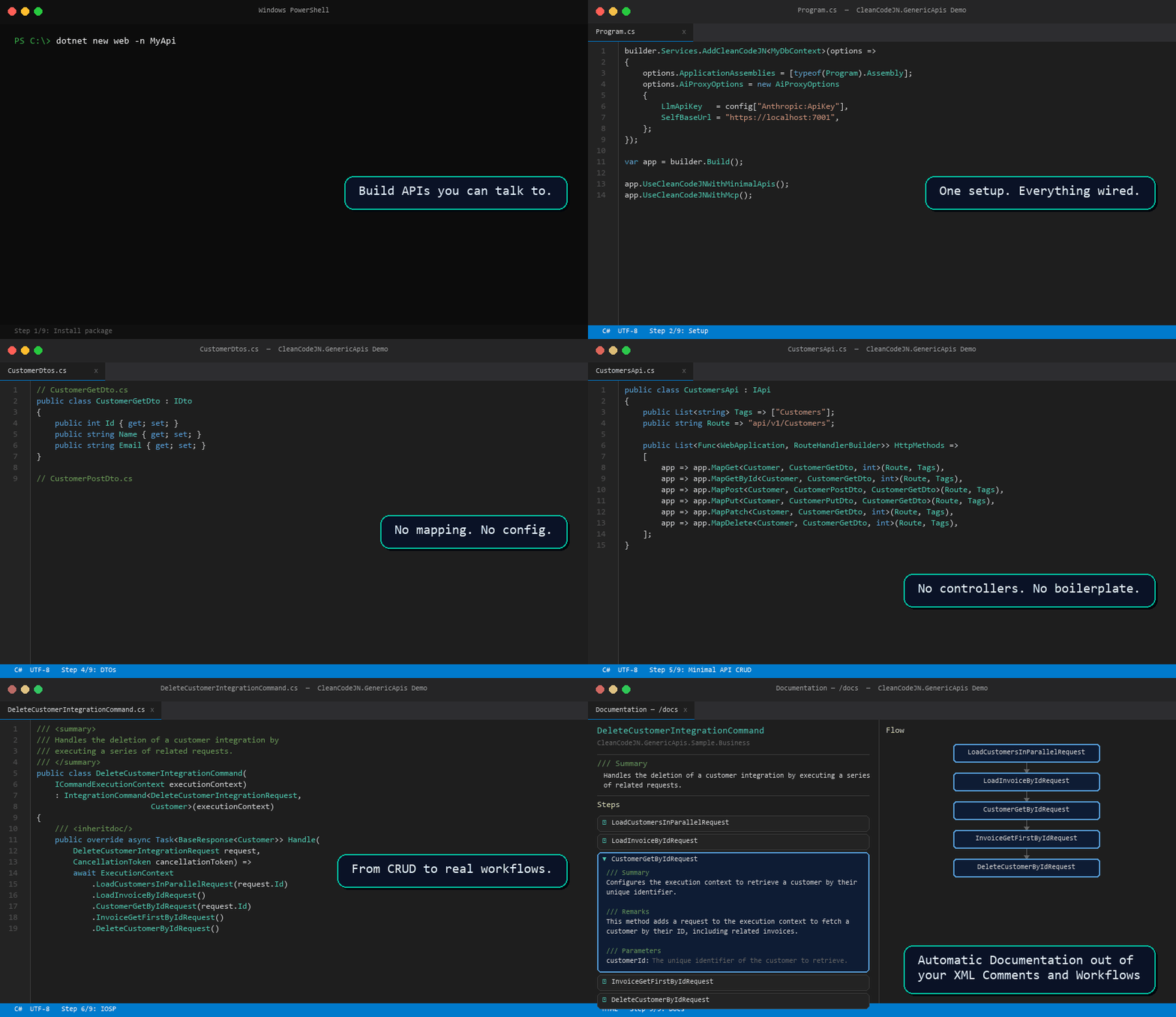
Build production-ready APIs instantly – from Minimal APIs and Controllers to fully integrated GraphQL endpoints and an AI-ready MCP Server with CRUD, filtering, sorting & paging – powered by Mediator, Mapster, EF Core, FluentValidation, and the IOSP architecture pattern.
⚡ Getting Started
dotnet add package CleanCodeJN.GenericApis
// Program.cs
builder.Services.AddCleanCodeJN<MyDbContext>(options =>
{
    options.ApplicationAssemblies =           // assemblies with your Commands, DTOs, Entities
    [
        typeof(YourBusiness.AssemblyRegistration).Assembly,
        typeof(YourCore.AssemblyRegistration).Assembly,
    ];
    options.ValidatorAssembly = typeof(YourCore.AssemblyRegistration).Assembly;
    options.AddDefaultLoggingBehavior = true; // optional
});

var app = builder.Build();

app.UseCleanCodeJNWithMinimalApis();   // REST: registers all IApi endpoints        → /api/...
app.UseCleanCodeJNWithGraphQL();       // GraphQL: auto-schema from entities/DTOs   → /graphql
app.UseCleanCodeJNWithMcp();           // MCP Server: every endpoint = AI tool      → /mcp
app.UseCleanCodeJNWithDocumentation(); // IOSP command docs from XML comments       → /docs
app.UseCleanCodeJNWithAiChat();        // AI chat with your API based on MCP server → /ai
app.MapControllers();

app.Run();
// Entity + DTO (naming convention: <EntityName>GetDto / PostDto / PutDto)
public class Customer : IEntity<int> { public int Id { get; set; } public string Name { get; set; } }
public class CustomerGetDto : IDto   { public int Id { get; set; } public string Name { get; set; } }

// Minimal API — full CRUD in ~10 lines
public class CustomersApi : IApi
{
    public List<string> Tags => ["Customers"];
    public string Route => "api/v1/Customers";
    public List<Func<WebApplication, RouteHandlerBuilder>> HttpMethods =>
    [
        app => app.MapGet<Customer, CustomerGetDto, int>(Route, Tags),
        app => app.MapGetById<Customer, CustomerGetDto, int>(Route, Tags),
        app => app.MapPost<Customer, CustomerPostDto, CustomerGetDto>(Route, Tags),
        app => app.MapPut<Customer, CustomerPutDto, CustomerGetDto>(Route, Tags),
        app => app.MapPatch<Customer, CustomerGetDto, int>(Route, Tags),
        app => app.MapDeleteRequest<Customer, CustomerGetDto, int>(Route, Tags, id => new DeleteCustomerRequest { Id = id }),
    ];
}

// IOSP: complex business logic as clean orchestration
public class DeleteCustomerCommand(ICommandExecutionContext ctx)
    : IntegrationCommand<DeleteCustomerRequest, Customer>(ctx)
{
    public override async Task<BaseResponse<Customer>> Handle(DeleteCustomerRequest request, CancellationToken ct) =>
        await ExecutionContext
            .GetCustomerByIdRequest(request.Id)
            .ValidateInvoicesRequest()
            .DeleteCustomerRequest()
            .Execute<Customer>(ct);
}
3. Program.cs — AI Proxy config (only if using /ai)
    options.AiProxyOptions = new AiProxyOptions
    {
        LlmApiKey = configuration["Anthropic:ApiKey"],
        SelfBaseUrl = configuration["SelfBaseUrl"],
        Model = "claude-sonnet-4-6",
        MaxTokens = 4096,
        ChatRoute = "/ai/chat",                    // default
        TestRoute = "/ai/test",                    // default
        McpPath = "/mcp",                          // default — must match McpOptions.Route
        EnableTestEndpoint = true,                 // set false in production
        AllowedCorsOrigins = ["*"],                // default — restrict in production e.g. ["https://myapp.com"]
        CorsPolicyName = "CleanCodeJNChat",        // default — change if it conflicts with existing policies
        DisableCertificateValidation = false,      // set true only in local dev
    };
4. The three building blocks
| Block | What you write | What you get |
|---|---|---|
| Entity | class Customer : IEntity<int> |
EF Core + Repository + GraphQL type |
| DTO | class CustomerGetDto : IDto |
Auto-mapped, Swagger schema, MCP output schema |
| IApi | class CustomersApi : IApi |
REST endpoints + MCP tools + GraphQL queries |
// Entity
public class Customer : IEntity<int>
{
    public int Id { get; set; }
    public string Name { get; set; }
}

// DTO (naming convention: <EntityName>GetDto / PostDto / PutDto)
public class CustomerGetDto : IDto
{
    public int Id { get; set; }
    public string Name { get; set; }
}

// Minimal API — all CRUD in ~10 lines
public class CustomersApi : IApi
{
    public List<string> Tags => ["Customers"];
    public string Route => "api/v1/Customers";

    public List<Func<WebApplication, RouteHandlerBuilder>> HttpMethods =>
    [
        app => app.MapGet<Customer, CustomerGetDto, int>(Route, Tags),
        app => app.MapGetById<Customer, CustomerGetDto, int>(Route, Tags),
        app => app.MapPost<Customer, CustomerPostDto, CustomerGetDto>(Route, Tags),
        app => app.MapPut<Customer, CustomerPutDto, CustomerGetDto>(Route, Tags),
        app => app.MapPatch<Customer, CustomerGetDto, int>(Route, Tags),
        app => app.MapDeleteRequest<Customer, CustomerGetDto, int>(Route, Tags, id => new DeleteCustomerRequest { Id = id }),
    ];
}
5. Feature flags — what each Use* call activates
| Call | Activates | Default route |
|---|---|---|
UseCleanCodeJNWithMinimalApis() |
All IApi REST endpoints |
/api + /swagger |
UseCleanCodeJNWithGraphQL() |
Auto-generated GraphQL schema | /graphql (configurable) |
UseCleanCodeJNWithMcp() |
MCP Server (AI-callable tools) | /mcp (configurable via McpOptions.Route) |
UseCleanCodeJNWithDocumentation() |
Automatic documentation from XML comments | /docs + /api/docs (configurable via route parameter) |
UseCleanCodeJNWithAiChat() |
AI chat SSE endpoint + optional test endpoint | /ai/chat + /ai/test (configurable via AiProxyOptions) |
Table of Contents
- ⚡ Getting Started
- 🚀 Generic Web APIs – Fast, Clean, Powerful
- Step by step explanation
- Add AddCleanCodeJN<IDataContext>() to your Program.cs
- These are the CleanCodeJN Options
- Add app.UseCleanCodeJNWithMinimalApis() when using Minimal APIs to your Program.cs
- Add app.UseCleanCodeJNWithGraphQL() when using automatic GraphQL to your Program.cs
- Add app.UseCleanCodeJNDocumentation() when using automatic Command documentation (from your XML comments) to your Program.cs
- 🤖 Add app.UseCleanCodeJNWithMcp() to expose your API as an AI-callable MCP Server
- When using Controllers add this to your Program.cs
- Start writing Minimal Apis by implementing IApi
- Extend standard CRUD operations by specific Where(), Include() or Select() clauses
- Use ApiCrudControllerBase for CRUD operations in controllers
- You can also override your Where, Include or Select clauses
- For using the /filtered api with a filter, just provide a serialized json as filter parameter
- The Type can be specified with these values
- Advanced Topics
- Built-in Support for Fluent Validation
- Implement your own specific Request
- Requests can also be marked as ICachableRequest, which uses IDistributedCache to cache the Response
- With your own specific Command using CleanCodeJN.Repository
- Map a custom request to an endpoint — route parameters bound straight into the request
- Custom Middlewares
- Use IOSP for complex business logic
- Derive from BaseIntegrationCommand
- Write Extensions on ICommandExecutionContext with Built in Requests or with your own
- Use WithParallelWhenAllRequests() to execute multiple requests in parallel and execute when all tasks are finished
- Use GetListParallelWhenAll() to get all results of WithParallelWhenAllRequests
- Use GetParallelWhenAllByIndex<T> to get the result of the WithParallelWhenAllRequests with a typed object by index
- Use IfRequest() to execute an optional request - continue when conditions are not satisfied
- Use IfBreakRequest() to execute an optional request - break whole process when conditions are not satisfied
- See the how clean your code will look like in the end
- 🏢 Multi-Tenancy Support
- 💬 AI Chat UI — /ai Page
- 🤖 Pluggable LLM Provider
- 🛡️ Pluggable Exception Handler
- Sample Code
✨ This package gives you
- ⚡ CRUD APIs in seconds — Minimal API or Controller-based, zero boilerplate
- 🧬 Auto-generated GraphQL — query/mutation/filter/sort/projection via HotChocolate
- 🤖 MCP Server — one line exposes your entire API as AI-callable tools (Claude, Cursor, …)
- 💬 AI Chat UI — ready-made
/aiBlazor page: chat with your API in natural language - 📦 Paging, filtering & projections — built-in, no extra code
- 🔀 Auto-mapping — Entities ⇄ DTOs by naming convention, no mapping config needed
- 🧪 FluentValidation — validators auto-discovered and executed on POST/PUT
- 🧼 IOSP architecture — clean orchestration of complex business logic
- 🆓 Free MediatR — uses the Apache-2.0-licensed MediatR 12.5.0 (last version before MediatR went commercial), so no commercial license is required
- 🏢 Multi-tenancy — per-tenant handler dispatch + per-tenant DB connection, zero boilerplate
- 📄 Command docs — auto-generated workflow documentation from XML comments at
/docs - 🚀 .NET 10, EF Core 10, fully testable & mockable
🧪 What is IOSP?
Integration Operation Segregation Principle — split your handlers into: Operations → real logic (DB, external APIs, …) Integrations → pure orchestration of other handlers, no logic of their own
Step by step explanation
Add AddCleanCodeJN<IDataContext>() to your Program.cs
builder.Services.AddCleanCodeJN<MyDbContext>(options => {});
- All Entity ⇔ DTO Mappings will be done automatically if the naming Convention will be applied: e.g.: Customer ⇔ CustomerGetDto.
- DTO has to start with Entity-Name and must inherits from IDto
- Entity must inherit from IEntity
These are the CleanCodeJN Options
builder.Services.AddCleanCodeJN<MyDbContext>(options =>
{
    // Assemblies containing your Commands, DTOs and Entities
    options.ApplicationAssemblies = [ typeof(YourAssembly).Assembly ];

    // Assembly with FluentValidation AbstractValidators
    options.ValidatorAssembly = typeof(YourAssembly).Assembly;

    // Use distributed memory cache (default: true)
    options.UseDistributedMemoryCache = true;

    // Enable built-in MediatR logging behavior
    options.AddDefaultLoggingBehavior = true;

    // Register custom open/closed MediatR pipeline behaviors
    options.OpenBehaviors   = [ typeof(MyBehavior<,>) ];
    options.ClosedBehaviors = [ typeof(MySpecificBehavior) ];

    // GraphQL auto-wiring
    options.GraphQLOptions = new GraphQLOptions { Get = true, Create = true, Update = true, Delete = true };

    // AI Proxy (for /ai chat page)
    options.AiProxyOptions = new AiProxyOptions
    {
        LlmApiKey = "sk-ant-...",
        SelfBaseUrl = "https://localhost:7001",
        CorsPolicyName = "CleanCodeJNChat",   // default
        DisableCertificateValidation = false, // set true only in local dev
    };

    // Assemblies scanned for custom Mapster IRegister mapping profiles
    options.MapsterMappingAssemblies = [ typeof(YourAssembly).Assembly ];

    // Override DTO suffix and GraphQL prefix naming conventions
    options.NamingConventions = new CleanCodeNamingConventions
    {
        GetDtoSuffix          = "GetDto",   // default
        PostDtoSuffix         = "PostDto",  // default
        PutDtoSuffix          = "PutDto",   // default
        GraphQLCreatePrefix   = "create",   // default → createCustomer
        GraphQLUpdatePrefix   = "update",   // default → updateCustomer
        GraphQLDeletePrefix   = "delete",   // default → deleteCustomer
    };
});
Add app.UseCleanCodeJNWithMinimalApis() when using Minimal APIs to your Program.cs
app.UseCleanCodeJNWithMinimalApis();
Add app.UseCleanCodeJNWithGraphQL() when using automatic GraphQL to your Program.cs
app.UseCleanCodeJNWithGraphQL();
Add app.UseCleanCodeJNWithDocumentation() when using automatic Command documentation (from your XML comments) to your Program.cs
app.UseCleanCodeJNWithDocumentation("/mydocs");   // default: /docs
// add <GenerateDocumentationFile>true</GenerateDocumentationFile> to your .csproj file
🤖 Add app.UseCleanCodeJNWithMcp() to expose your API as an AI-callable MCP Server
One line of code turns your entire API into a Model Context Protocol (MCP) Server — discoverable and executable by any AI assistant that supports the standard MCP Streamable HTTP transport (Claude, Cursor, Continue, and more).
app.UseCleanCodeJNWithMcp();
Use the optional delegate to configure the endpoint:
app.UseCleanCodeJNWithMcp(options =>
{
    // change the endpoint route (default: /mcp)
    // also update AiProxyOptions.McpPath to the same value when using AI chat
    options.Route = "/tools";

    // exclude all DELETE tools so AI assistants cannot delete data
    options.ExcludeTools = name => name.StartsWith("delete_");

    // or exclude specific routes
    options.ExcludeTools = name => name.Contains("admin");
});
Tool names follow the pattern {httpMethod}_{route_in_snake_case}, e.g. delete_api_customers_{id}.
This registers a POST /mcp endpoint (route configurable via McpOptions.Route) implementing the MCP Streamable HTTP transport (protocol version 2024-11-05). No custom protocol, no vendor lock-in — any standard MCP client works out of the box.
What gets auto-generated?
CRUD tools are generated automatically from your Controllers and Minimal APIs — including full JSON schemas derived from your DTOs:
| Tool | Description |
|---|---|
list_customer |
Retrieve all Customer records |
get_customer_by_id |
Retrieve a single Customer by ID |
create_customer |
Create a new Customer (schema from CustomerPostDto) |
update_customer |
Update an existing Customer (schema from CustomerPutDto) |
delete_customer |
Delete a Customer by ID |
Custom endpoint tools are generated from any Minimal API endpoint annotated with .WithSummary() / .WithDescription():
public List<Func<WebApplication, RouteHandlerBuilder>> HttpMethods =>
[
    // Standard CRUD → auto-discovered, no annotation needed
    app => app.MapGet<Customer, CustomerGetDto, int>(Route, Tags),
    app => app.MapPost<Customer, CustomerPostDto, CustomerGetDto>(Route, Tags),

    // Custom endpoints → annotate to expose as MCP tools
    app => app.MapGetRequest(Route + "/cached", Tags, async ([FromServices] ApiBase api) =>
            await api.Handle<Customer, List<CustomerGetDto>>(new CachedCustomerRequest()))
        .WithSummary("Get cached customers")
        .WithDescription("Returns a cached list of customers. Served from cache if available."),

    app => app.MapDeleteRequest<Customer, CustomerGetDto, int>(Route, Tags, id => new DeleteCustomerIntegrationRequest { Id = id })
        .WithSummary("Delete customer via integration flow")
        .WithDescription("Deletes a customer using the full integration delete workflow."),
];
Enrich tool schemas with DTO XML comments
Add /// <summary> comments to your DTO properties — the MCP server reads them automatically and includes them as description fields in the JSON schema. This tells the AI assistant exactly what each field means, including constraints and examples.
Step 1: Enable XML doc generation in your DTO project's .csproj:
<PropertyGroup>
  <GenerateDocumentationFile>true</GenerateDocumentationFile>
</PropertyGroup>
Step 2: Add XML comments to your DTO properties:
public class CustomerPostDto : IDto
{
    /// <summary>Full name of the customer, e.g. 'Acme Corp'. Maximum 100 characters.</summary>
    public string Name { get; set; }
}

public class CustomerPutDto : IDto
{
    /// <summary>Unique identifier of the customer to update.</summary>
    public int Id { get; set; }

    /// <summary>New full name of the customer, e.g. 'Acme Corp'. Maximum 100 characters.</summary>
    public string Name { get; set; }
}
The MCP tool schema for create_customer will then look like:
{
  "name": "create_customer",
  "inputSchema": {
    "properties": {
      "name": {
        "type": "string",
        "description": "Full name of the customer, e.g. 'Acme Corp'. Maximum 100 characters."
      }
    }
  }
}
This enables AI assistants to ask the right questions when creating or updating records — e.g. "What is the customer's full name?" — before sending the request.
IOSP Command tools are generated from your XML documentation — giving AI assistants insight into your business workflows:
/// <summary>Handles the deletion of a customer including all related data.</summary>
/// <remarks>Executes in parallel: retrieves customer, validates invoices, then deletes.</remarks>
public class DeleteCustomerIntegrationCommand(...) : IntegrationCommand<...> { }
All tool calls go through the standard HTTP pipeline — your authentication and authorization middleware applies automatically.
Connect any MCP client
Claude Desktop (claude_desktop_config.json):
{
  "mcpServers": {
    "my-api": {
      "url": "https://your-api.com/mcp"
    }
  }
}
Cursor (.cursor/mcp.json):
{
  "mcpServers": {
    "my-api": {
      "url": "https://your-api.com/mcp"
    }
  }
}
Once connected, your AI assistant knows your full API surface and can answer "what can you do with customers?" or execute "create a customer named Acme Corp" directly.
When using Controllers add this to your Program.cs
builder.Services.AddControllers()
    .AddNewtonsoftJson(); // this is needed for "http patch" only. If you do not need to use patch, you can remove this line

// After Build()
app.MapControllers();
When using GraphQL add this to your Program.cs
builder.Services.AddCleanCodeJN<MyDbContext>(options =>
{
    options.ApplicationAssemblies =
    [
        typeof(CleanCodeJN.GenericApis.Sample.Business.AssemblyRegistration).Assembly,
        typeof(CleanCodeJN.GenericApis.Sample.Core.AssemblyRegistration).Assembly,
        typeof(CleanCodeJN.GenericApis.Sample.Domain.AssemblyRegistration).Assembly
    ];
    options.ValidatorAssembly = typeof(CleanCodeJN.GenericApis.Sample.Core.AssemblyRegistration).Assembly;

    // Enable GraphQL with all CRUD operations
    options.GraphQLOptions = new GraphQLOptions
    {
        Get = true,
        Create = true,
        Update = true,
        Delete = true,
        AddAuthorizationWithPolicyName = "MyPolicy", // optional for adding authorization policy

        // optional: extend the HotChocolate schema after CleanCodeJN auto-wiring
        ConfigureSchema = schema =>
        {
            schema.AddType<UploadType>();
            schema.AddErrorFilter<MyErrorFilter>();
        }
    };
});

// Optional: Add Authentication and Authorization if needed
builder.Services.AddAuthorization(options =>
{
    options.AddPolicy("MyPolicy", policy =>
    {
        policy.RequireAuthenticatedUser();
        policy.RequireClaim("role", "admin");
    });
});
Start writing Minimal Apis by implementing IApi
public class CustomersV1Api : IApi
{
    public List<string> Tags => ["Customers Minimal API"];

    public string Route => $"api/v1/Customers";

    public List<Func<WebApplication, RouteHandlerBuilder>> HttpMethods =>
    [
        app => app.MapGet<Customer, CustomerGetDto, int>(
            Route,
            Tags,
            where: x => x.Name.StartsWith("Customer"),
            includes: [x => x.Invoices],
            select: x => new Customer { Name = x.Name },
            ignoreQueryFilters: true),

        app => app.MapGetPaged<Customer, CustomerGetDto, int>(Route, Tags),

        app => app.MapGetFiltered<Customer, CustomerGetDto, int>(Route, Tags),

        app => app.MapGetById<Customer, CustomerGetDto, int>(Route, Tags),

        app => app.MapPut<Customer, CustomerPutDto, CustomerGetDto>(Route, Tags),

        app => app.MapPost<Customer, CustomerPostDto, CustomerGetDto>(Route, Tags),

        app => app.MapPatch<Customer, CustomerGetDto, int>(Route, Tags),

        // Or use a custom Command with MapDeleteRequest()
        app => app.MapDeleteRequest<Customer, CustomerGetDto, int>(Route, Tags, id => new DeleteCustomerIntegrationRequest { Id = id })
    ];
}
Extend standard CRUD operations by specific Where(), Include() or Select() clauses
public class CustomersV1Api : IApi
{
    public List<string> Tags => ["Customers Minimal API"];

    public string Route => $"api/v1/Customers";

    public List<Func<WebApplication, RouteHandlerBuilder>> HttpMethods =>
    [
         app => app.MapGet<Customer, CustomerGetDto, int>(Route, Tags, where: x => x.Name.StartsWith("a"), select: x => new Customer { Name = x.Name }),
    ];
}
Use ApiCrudControllerBase for CRUD operations in controllers
[Tags("Customers Controller based")]
[Route($"api/v2/[controller]")]

public class CustomersController(IMediator commandBus, ICleanCodeMapper mapper)
    : ApiCrudControllerBase<Customer, CustomerGetDto, CustomerPostDto, CustomerPutDto, int>(commandBus, mapper)
{
}
You can also override your Where, Include or Select clauses
/// <summary>
/// Customers Controller based
/// </summary>
/// <param name="commandBus">IMediatr instance.</param>
/// <param name="mapper">ICleanCodeMapper instance.</param>
[Tags("Customers Controller based")]
[Route($"api/v2/[controller]")]
public class CustomersController(IMediator commandBus, ICleanCodeMapper mapper)
    : ApiCrudControllerBase<Customer, CustomerGetDto, CustomerPostDto, CustomerPutDto, int>(commandBus, mapper)
{
    /// <summary>
    /// Where clause for the Get method.
    /// </summary>
    public override Expression<Func<Customer, bool>> GetWhere => x => x.Name.StartsWith("Customer");

    /// <summary>
    /// Includes for the Get method.
    /// </summary>
    public override List<Expression<Func<Customer, object>>> GetIncludes => [x => x.Invoices];

    /// <summary>
    /// Select for the Get method.
    /// </summary>
    public override Expression<Func<Customer, Customer>> GetSelect => x => new Customer { Id = x.Id, Name = x.Name };

    /// <summary>
    /// AsNoTracking for the Get method.
    /// </summary>
    public override bool AsNoTracking => true;
}
For using the /filtered api with a filter, just provide a serialized json as filter parameter, like this:
{
    "Condition" : 0, // 0 = AND; 1 = OR
    "Filters": [
        {
            "Field": "Name",
            "Value": "aac",
            "Type": 0
        },
        {
            "Field": "Id",
            "Value": "3",
            "Type": 1
        }
    ]
}
Which means: Give me all Names which CONTAINS "aac" AND have Id EQUALS 3. So string Types use always CONTAINS and integer types use EQUALS. All filters are combined with ANDs.
The Type can be specified with these values
public enum FilterTypeEnum
{
    STRING = 0,
    INTEGER = 1,
    DOUBLE = 2,
    INTEGER_NULLABLE = 3,
    DOUBLE_NULLABLE = 4,
    DATETIME = 5,
    DATETIME_NULLABLE = 6,
    GUID = 7,
    GUID_NULLABLE = 8,
}
Advanced Topics
Built-in Support for Fluent Validation:
Just write your AbstractValidators<T>. They will be automatically executed on generic POST and generic PUT actions:
public class CustomerPostDtoValidator : AbstractValidator<CustomerPostDto>
{
    public CustomerPostDtoValidator()
    {
        RuleFor(x => x.Name)
            .NotEmpty()
            .MaximumLength(10);
    }
public class CustomerPutDtoValidator : AbstractValidator<CustomerPutDto>
{
    public CustomerPutDtoValidator()
    {
        RuleFor(x => x.Id)
            .GreaterThan(0);

        RuleFor(x => x.Name)
            .NotEmpty()
            .MaximumLength(10)
            .CreditCard();
    }
}
Implement your own specific Request:
public class SpecificDeleteRequest : IRequest<BaseResponse<Customer>>
{
    public required int Id { get; init; }
}
Requests can also be marked as ICachableRequest, which uses IDistributedCache to cache the Response:
public class SpecificDeleteRequest : IRequest<BaseResponse<Customer>>, ICachableRequest
{
    public required int Id { get; init; }

    public bool BypassCache { get; }

    public string CacheKey => "Your Key";

    public TimeSpan? CacheDuration => TimeSpan.FromHours(168);
}
With your own specific Command using CleanCodeJN.Repository
public class SpecificDeleteCommand(IRepository<Customer, int> repository) : IRequestHandler<SpecificDeleteRequest, BaseResponse<Customer>>
{
    public async Task<BaseResponse<Customer>> Handle(SpecificDeleteRequest request, CancellationToken cancellationToken)
    {
        var deletedCustomer = await repository.Delete(request.Id, cancellationToken);

        return await BaseResponse<Customer>.Create(deletedCustomer is not null, deletedCustomer);
    }
}
Map a custom request to an endpoint — route parameters bound straight into the request
For GET (list and by-id) and DELETE, the route/query parameters can bind directly into your request via [AsParameters]. The request type carries every parameter itself, so you need no factory delegate and no IRepository/mapping in the IApi — and it scales to any number of route parameters (one property per parameter). Property names match the route tokens (case-insensitive).
// The request IS the parameter container — bound from the route:
public record GetOrdersByCustomerRequest(int CustomerId, int Year) : IRequest<BaseListResponse<Order>>;
public record GetOrderByIdRequest(int Id)                          : IRequest<BaseResponse<Order>>;
public record DeleteOrderRequest(int Id)                           : IRequest<BaseResponse<Order>>;

public class OrdersApi : IApi
{
    public List<string> Tags => ["Orders"];
    public string Route => "api/v1/Orders";

    public List<Func<WebApplication, RouteHandlerBuilder>> HttpMethods =>
    [
        // GET list — returns List<OrderGetDto> (pass the item DTO); request bound from the route
        app => app.MapGetRequest<Order, OrderGetDto, GetOrdersByCustomerRequest>($"{Route}/customer/{{customerId}}/year/{{year}}", Tags),

        // GET single — returns OrderGetDto
        app => app.MapGetByIdRequest<Order, OrderGetDto, GetOrderByIdRequest>($"{Route}/{{id}}", Tags),

        // DELETE — id from the path (.../{id}) or the query (?id=), depending on the route you pass
        app => app.MapDeleteRequest<Order, OrderGetDto, DeleteOrderRequest>($"{Route}/{{id}}", Tags),
    ];
}
The repository work stays in the command (handler), exactly like above — e.g. GetOrdersByCustomerCommand(IRepository<Order, int> repo) : IRequestHandler<GetOrdersByCustomerRequest, BaseListResponse<Order>>.
POST/PUT carry their payload in the body, so they bind the DTO/request from the body — use
MapPostRequest/MapPutRequestwith the body request; route-parameter binding ([AsParameters]) is not needed there. The only case that still needs a delegate is a body plus extra route parameters (e.g.POST .../{parentId}/child); use the rawMapPostRequest(route, tags, handler)overload for that.
Custom Middlewares
CleanCodeJN.GenericApis is fully compatible with the standard ASP.NET Core middleware pipeline.
You can easily add custom middlewares for authentication, logging, exception handling, or any other cross-cutting concern — before or after the CleanCodeJN setup.
Where to Add Middlewares
Custom middlewares should be registered in your Program.cs after the AddCleanCodeJN() call, but before the CleanCodeJN
middlewares such as UseCleanCodeJNWith. Global mediator behaviours for logging or caching can directly be added in the AddCleanCodeJN() options.
There already is a default logging behaviour included, which can be enabled in the options. This behaviour logs the execution and exection time of each command.
Example Structure
var builder = WebApplication.CreateBuilder(args);

// Add CleanCodeJN
builder.Services.AddCleanCodeJN<MyDbContext>(options =>
{
    options.AddDefaultLoggingBehavior = true; // Enables default logging behaviour
    options.OpenBehaviors = [typeof(CustomBehavior<,>)]; // Adds custom behaviour with 2 generic parameters for TRequest, TResponse

    options.ApplicationAssemblies = [typeof(Program).Assembly];
    options.ValidatorAssembly = typeof(Program).Assembly;
});

// Add custom services
builder.Services.AddLogging();
builder.Services.AddAuthentication("Bearer")
    .AddJwtBearer("Bearer", options =>
    {
        options.Authority = "https://your-keycloak-domain/auth/realms/yourrealm";
        options.Audience = "your-api";
    });
builder.Services.AddAuthorization();

var app = builder.Build();

// Add your middlewares in the right order

// Authentication & Authorization
app.UseAuthentication();
app.UseAuthorization();

// Custom Logging Middleware
app.Use(async (context, next) =>
{
    var logger = context.RequestServices.GetRequiredService<ILogger<Program>>();
    logger.LogInformation("➡️ Request: {Method} {Path}", context.Request.Method, context.Request.Path);
    await next();
    logger.LogInformation("⬅️ Response: {StatusCode}", context.Response.StatusCode);
});

// Global Exception Handling
app.Use(async (context, next) =>
{
    try
    {
        await next();
    }
    catch (Exception ex)
    {
        var logger = context.RequestServices.GetRequiredService<ILogger<Program>>();
        logger.LogError(ex, "Unhandled exception occurred");

        context.Response.StatusCode = 500;
        await context.Response.WriteAsJsonAsync(new
        {
            Title = "Unexpected Error",
            Detail = ex.Message
        });
    }
});

// CleanCodeJN Middlewares
app.UseCleanCodeJNWithMinimalApis();
app.UseCleanCodeJNWithGraphQL();
app.UseCleanCodeJNWithMcp();
app.UseCleanCodeJNDocumentation();

// Run
app.Run();
Use IOSP for complex business logic
Derive from BaseIntegrationCommand:
public class YourIntegrationCommand(ICommandExecutionContext executionContext)
    : IntegrationCommand<YourIntegrationRequest, YourDomainObject>(executionContext)
Write Extensions on ICommandExecutionContext with Built in Requests or with your own
public static ICommandExecutionContext CustomerGetByIdRequest(
    this ICommandExecutionContext executionContext, int customerId)
    => executionContext.WithRequest(
            () => new GetByIdRequest<Customer>
            {
                Id = customerId,
                Includes = [x => x.Invoices, x => x.OtherDependentTable],
            },
            CommandConstants.CustomerGetById);
Use WithParallelWhenAllRequests() to execute multiple requests in parallel and execute when all tasks are finished:
   executionContext.WithParallelWhenAllRequests(
                [
                    () => new GetByIdRequest<Customer, int>
                          {
                              Id = request.Id,
                          },
                    () => new GetByIdRequest<Customer, int>
                          {
                              Id = request.Id,
                          },
                ])
Use GetListParallelWhenAll() to get all results of WithParallelWhenAllRequests():
   .WithRequest(
                () => new YourSpecificRequest
                {
                    Results = executionContext.GetListParallelWhenAll("Parallel Block"),
                })
Use GetParallelWhenAllByIndex<T>() to get the result of the WithParallelWhenAllRequests() with a typed object by index:
   .WithRequest(
                () => new GetByIdRequest<Invoice, Guid>
                {
                    Id = executionContext.GetParallelWhenAllByIndex<Invoice>("Parallel Block", 1).Id,
                })
Use IfRequest() to execute an optional request - continue when conditions are not satisfied:
    executionContext.IfRequest(() => new GetByIdRequest<Customer, int> { Id = request.Id },
                               ifBeforePredicate: () => true,
                               ifAfterPredicate: response => response.Succeeded)
Use IfBreakRequest() to execute an optional request - break whole process when conditions are not satisfied:
    executionContext.IfBreakRequest(() => new GetByIdRequest<Customer, int> { Id = request.Id },
                                    ifBeforePredicate: () => true,
                                    ifAfterPredicate: response => response.Succeeded)
This is how clean your code will look like in the end
public class YourIntegrationCommand(ICommandExecutionContext executionContext)
    : IntegrationCommand<YourIntegrationRequest, Customer>(executionContext)
{
    public override async Task<BaseResponse<Customer>> Handle(YourIntegrationRequest request, CancellationToken cancellationToken) =>
        await ExecutionContext
            .CandidateGetByIdRequest(request.Dto.CandidateId)
            .CustomerGetByIdRequest(request.Dto.CustomerIds)
            .GetOtherStuffRequest(request.Dto.XYZType)
            .PostSomethingRequest(request.Dto)
            .SendMailRequest()
            .Execute<Customer>(cancellationToken);
}
💬 AI Chat UI — /ai Page
The CleanCodeJN.GenericApis.Chat package provides a ready-made Blazor WebAssembly chat page at /ai. It connects directly to your backend's MCP server and lets users interact with your API through natural language — powered by Claude.
Requires
UseCleanCodeJNWithMcp()on the backend.
Install
dotnet add package CleanCodeJN.GenericApis.Chat # Blazor WASM UI component
Backend — Program.cs additions
Set AiProxyOptions inside AddCleanCodeJN and call UseCleanCodeJNWithAiChat() to register the /ai/chat SSE endpoint:
builder.Services.AddCleanCodeJN<MyDbContext>(options =>
{
    options.AiProxyOptions = new AiProxyOptions
    {
        LlmApiKey                  = configuration["Anthropic:ApiKey"],
        SelfBaseUrl                = "https://localhost:7132",
        Model                      = "claude-sonnet-4-6",
        MaxTokens                  = 8096,
        ChatRoute                  = "/ai/chat",           // default
        TestRoute                  = "/ai/test",           // default
        McpPath                    = "/mcp",               // default — must match McpOptions.Route
        EnableTestEndpoint         = true,                 // set false in production
        AllowedCorsOrigins         = ["*"],                // default — restrict in production
        CorsPolicyName             = "CleanCodeJNChat",    // default
        DisableCertificateValidation = false,              // set true only in local dev
    };
});

var app = builder.Build();

app.UseCleanCodeJNWithMcp();     // registers MCP at McpOptions.Route (default: /mcp)
app.UseCleanCodeJNWithAiChat();  // registers ChatRoute (default: /ai/chat) and optionally TestRoute (default: /ai/test)
Blazor WASM — Program.cs
using CleanCodeJN.GenericApis.Chat.Extensions;

builder.Services.AddMudServices();

builder.Services.AddCleanCodeJNWithAiChat(options =>
{
    options.BackendUrl = "https://localhost:7132"; // URL of your CleanCodeJN backend
    options.Title = "My AI Assistant";            // Title shown in the app bar
    options.ShowToolCalls = true;                 // Show tool call chips in the chat
    // options.BearerToken = "your-token";        // Optional: bearer token for auth
});
App.razor — register the /ai route from the library
<Router AppAssembly="@typeof(App).Assembly"
        AdditionalAssemblies="@(new[] { typeof(CleanCodeJN.GenericApis.Chat.Pages.AiChatPage).Assembly })">
    <Found Context="routeData">
        <RouteView RouteData="@routeData" DefaultLayout="@typeof(Layout.MainLayout)" />
    </Found>
</Router>
Layout/MainLayout.razor — MudBlazor dark theme
@inherits LayoutComponentBase

<MudThemeProvider IsDarkMode="true" Theme="_theme" />
<MudPopoverProvider />
<MudDialogProvider />
<MudSnackbarProvider />

@Body

@code {
    private readonly MudTheme _theme = new()
    {
        PaletteDark = new PaletteDark
        {
            Primary = "#4CAF50",
            AppbarBackground = "#0d1b2a",
            Background = "#0a1520",
            Surface = "#112233",
        }
    };
}
What you get
| Feature | Description |
|---|---|
| Streaming chat | Claude responses stream token by token via SSE |
| Tool sidebar | All MCP tools listed — click to insert into input |
| Tool call chips | Visual indicator when Claude calls a tool and receives a result |
| Markdown rendering | Tables, code blocks, lists rendered with syntax highlighting |
| Dark theme | CleanCodeJN-branded dark UI out of the box |
| Auto-redirect | App opens directly at /ai on start |
🔀 Mapping with Mapster
CleanCodeJN internally uses an ICleanCodeMapper abstraction backed by Mapster. Entity ⇄ DTO pairs are auto-discovered by naming convention — no manual mapping registration required.
Custom mappings via IRegister profiles
To customize mappings, create a Mapster IRegister profile and add its assembly to MapsterMappingAssemblies. Every IRegister implementation found in those assemblies is applied on top of the auto-discovered mappings.
public class CustomerMappingProfile : IRegister
{
    public void Register(TypeAdapterConfig config)
    {
        config.NewConfig<Customer, CustomerGetDto>()
              .Map(d => d.FullAddress, s => s.Street + ", " + s.City);
    }
}
builder.Services.AddCleanCodeJN<MyDbContext>(options =>
{
    // Assemblies scanned for IRegister mapping profiles
    options.MapsterMappingAssemblies = [ typeof(CustomerMappingProfile).Assembly ];
});
CleanCodeJN registers ICleanCodeMapper in the DI container. Inject it wherever you need object mapping:
public class MyService(ICleanCodeMapper mapper)
{
    public CustomerGetDto Map(Customer customer) => mapper.Map<CustomerGetDto>(customer);
}
🤖 Pluggable LLM Provider
By default the AI Chat feature uses Anthropic Claude via AnthropicLlmProvider. If you want to use a different LLM (OpenAI, Azure OpenAI, local models, …) you can replace the provider by implementing ILlmProvider and registering it after AddCleanCodeJN:
// 1. Implement the interface
public class MyOpenAiProvider(IOptions<AiProxyOptions> options) : ILlmProvider
{
    public async IAsyncEnumerable<ChatStreamEvent> StreamAsync(
        ChatRequest request, string bearerToken, CancellationToken cancellationToken)
    {
        // call your preferred LLM here and yield ChatStreamEvent objects
        yield return new ChatStreamEvent("text", Content: "Hello from my custom provider!");
    }
}

// 2. Register it AFTER AddCleanCodeJN — it overrides the default AnthropicLlmProvider
builder.Services.AddCleanCodeJN<MyDbContext>(options =>
{
    options.AiProxyOptions = new AiProxyOptions { SelfBaseUrl = "https://localhost:7001" };
});

builder.Services.AddScoped<ILlmProvider, MyOpenAiProvider>(); // overrides Anthropic default
ChatStreamEvent types your provider should yield:
| Type | Purpose |
|---|---|
"text" |
A text delta to stream to the client (Content field) |
"tool_call" |
Claude/LLM is calling an MCP tool (ToolName, ToolArgs) |
"tool_result" |
Result of the tool call (ToolName, ToolResult) |
"error" |
An error occurred (Content with error message) |
🛡️ Pluggable Exception Handler
All unhandled exceptions are automatically returned as ProblemDetails (RFC 7807) by the built-in CleanCodeExceptionHandler. It is activated automatically by every UseCleanCodeJN* method — no setup required.
If you need explicit control over the position in the middleware pipeline (e.g. to catch exceptions from your own early middleware), call it manually before the other Use* calls:
var app = builder.Build();

app.UseCleanCodeJNExceptionHandler(); // explicit early placement
app.UseCleanCodeJNWithMinimalApis();
Override the default behaviour
Derive from CleanCodeExceptionHandler and map exception types to appropriate HTTP status codes:
public class MyExceptionHandler : CleanCodeExceptionHandler
{
    public override async ValueTask<bool> TryHandleAsync(
        HttpContext httpContext, Exception exception, CancellationToken ct)
    {
        if (exception is KeyNotFoundException)
        {
            httpContext.Response.StatusCode = 404;
            await httpContext.Response.WriteAsJsonAsync(
                new ProblemDetails { Title = exception.Message, Status = 404 }, ct);
            return true;
        }

        // fall back to default (400 + ProblemDetails with stack trace)
        return await base.TryHandleAsync(httpContext, exception, ct);
    }
}
Register your handler before AddCleanCodeJN — ASP.NET Core tries handlers in registration order, so the first one registered wins:
builder.Services.AddExceptionHandler<MyExceptionHandler>(); // tried first
builder.Services.AddCleanCodeJN<MyDbContext>(...);          // CleanCodeExceptionHandler = fallback
🏷️ Configurable Naming Conventions
By default, CleanCodeJN discovers DTOs and generates GraphQL field names using these conventions:
| Convention | Default | Example |
|---|---|---|
| GET DTO suffix | GetDto |
CustomerGetDto |
| POST DTO suffix | PostDto |
CustomerPostDto |
| PUT DTO suffix | PutDto |
CustomerPutDto |
| GraphQL create prefix | create |
createCustomer |
| GraphQL update prefix | update |
updateCustomer |
| GraphQL delete prefix | delete |
deleteCustomer |
Override any of these via CleanCodeOptions.NamingConventions:
builder.Services.AddCleanCodeJN<MyDbContext>(options =>
{
    options.NamingConventions = new CleanCodeNamingConventions
    {
        GetDtoSuffix        = "ReadModel",  // CustomerReadModel
        PostDtoSuffix       = "CreateDto",  // CustomerCreateDto
        PutDtoSuffix        = "UpdateDto",  // CustomerUpdateDto
        GraphQLCreatePrefix = "add",        // addCustomer
        GraphQLUpdatePrefix = "edit",       // editCustomer
        GraphQLDeletePrefix = "remove",     // removeCustomer
    };
});
🏢 Multi-Tenancy Support
Built-in multi-tenancy lets you route requests to tenant-specific handlers and connect each tenant to its own database — with zero boilerplate and full MediatR pipeline support (caching, logging, custom behaviors all run normally).
How it works
- Configure the tenant source in
Program.cs - Declare tenant-specific handlers by implementing
IMultiTenantHandler - Connect your
DbContextto the resolved connection string viaTenantContext
The TenantDispatchBehavior runs as the innermost MediatR pipeline behavior. It extracts the tenant name, populates the scoped TenantContext, and routes to the matching handler. If no tenant-specific handler exists the default handler is called as usual.
1. Configure TenantOptions in Program.cs
builder.Services.AddCleanCodeJN<MyDbContext>(options =>
{
    // Read tenant name from a JWT claim (simplest case)
    options.TenantOptions = new TenantOptions
    {
        ClaimName = "tenant_id",
        ConnectionStringResolver = tenantName => configuration.GetConnectionString(tenantName),
    };
});
Need more control? Use the TenantResolver hook — it receives the full HttpContext:
options.TenantOptions = new TenantOptions
{
    // From a request header (e.g. set by an API gateway)
    TenantResolver = ctx => ctx.Request.Headers["X-Tenant-ID"],

    // From a subdomain: enbw.api.company.com → "enbw"
    TenantResolver = ctx => ctx.Request.Host.Host.Split('.')[0],

    // From a route segment: /api/enbw/customers → "enbw"
    TenantResolver = ctx => ctx.GetRouteValue("tenant")?.ToString(),

    // Combined: JWT claim first, header as fallback
    TenantResolver = ctx =>
        ctx.User?.FindFirst("tenant_id")?.Value
        ?? ctx.Request.Headers["X-Tenant-ID"].FirstOrDefault(),

    ConnectionStringResolver = tenantName => configuration.GetConnectionString(tenantName),
};
Add the connection strings to appsettings.json:
{
  "ConnectionStrings": {
    "DefaultConnection": "Server=...;Database=MyApp;",
    "Tenant1":           "Server=...;Database=MyApp_Tenant1;",
    "Tenant2":           "Server=...;Database=MyApp_Tenant2;"
  }
}
2. Declare tenant-specific handlers with IMultiTenantHandler
Implement IMultiTenantHandler on any IRequestHandler and return a constant tenant name. The handler is auto-discovered at startup — no registration, no attributes needed.
// Handles DeleteCustomerRequest only when tenant = "Tenant1"
public class Tenant1DeleteCustomerCommand(ICommandExecutionContext ctx)
    : IntegrationCommand<DeleteCustomerRequest, Customer>(ctx), IMultiTenantHandler
{
    public string TenantName => "Tenant1";

    public override async Task<BaseResponse<Customer>> Handle(
        DeleteCustomerRequest request, CancellationToken ct) =>
        await ExecutionContext
            .GetCustomerByIdRequest(request.Id)
            .DeleteCustomerRequest()
            .Execute<Customer>(ct);
}

// Handles DeleteCustomerRequest only when tenant = "Tenant2"
public class Tenant2DeleteCustomerCommand(ICommandExecutionContext ctx)
    : IntegrationCommand<DeleteCustomerRequest, Customer>(ctx), IMultiTenantHandler
{
    public string TenantName => "Tenant2";

    public override async Task<BaseResponse<Customer>> Handle(
        DeleteCustomerRequest request, CancellationToken ct) =>
        await ExecutionContext
            .GetCustomerByIdRequest(request.Id)
            .DeleteCustomerRequest()
            .Execute<Customer>(ct);
}

// Default handler — called for all other tenants (or when TenantOptions is not configured)
public class DeleteCustomerCommand(ICommandExecutionContext ctx)
    : IntegrationCommand<DeleteCustomerRequest, Customer>(ctx)
{
    public override async Task<BaseResponse<Customer>> Handle(
        DeleteCustomerRequest request, CancellationToken ct) =>
        await ExecutionContext
            .GetCustomerByIdRequest(request.Id)
            .DeleteCustomerRequest()
            .Execute<Customer>(ct);
}
Dispatch rules:
| Tenant claim | Handler invoked |
|---|---|
| "Tenant1" | Tenant1DeleteCustomerCommand |
| "Tenant2" | Tenant2DeleteCustomerCommand |
| anything else / no claim | DeleteCustomerCommand (default) |
3. Connect your DbContext to the tenant connection string
Inject the scoped TenantContext into your DbContext. It is always populated before the first database operation runs.
public class MyDbContext(IConfiguration configuration, TenantContext tenantContext = null)
    : DbContext, IDataContext
{
    protected override void OnConfiguring(DbContextOptionsBuilder optionsBuilder)
    {
        var connectionString = tenantContext?.ConnectionString        // set by TenantDispatchBehavior
            ?? configuration.GetConnectionString("DefaultConnection"); // fallback (no tenant)

        optionsBuilder.UseSqlServer(connectionString);
    }
}
TenantContext is optional (= null) so the DbContext works without multi-tenancy configured at all.
Complete pipeline for a tenant request
HTTP request  →  JWT claim "tenant_id" = "Tenant1"
    CachingBehavior       (runs as usual)
    LoggingBehavior       (runs as usual)
    [your custom behaviors]
    TenantDispatchBehavior
        → TenantContext.TenantName      = "Tenant1"
        → TenantContext.ConnectionString = "Server=...Tenant1..."
        → Registry finds Tenant1DeleteCustomerCommand
        → Tenant1DeleteCustomerCommand.Handle()
            → DbContext.OnConfiguring() uses Tenant1 connection string
Sample Code
| Product | Versions Compatible and additional computed target framework versions. |
|---|---|
| .NET | net10.0 is compatible. net10.0-android was computed. net10.0-browser was computed. net10.0-ios was computed. net10.0-maccatalyst was computed. net10.0-macos was computed. net10.0-tvos was computed. net10.0-windows was computed. |
-
net10.0
- Anthropic.SDK (>= 5.10.0)
- CleanCodeJN.GenericApis.Abstractions (>= 4.1.0)
- CleanCodeJN.Repository.EntityFramework (>= 2.0.1)
- FluentValidation (>= 12.1.1)
- FluentValidation.AspNetCore (>= 11.3.1)
- HotChocolate.AspNetCore (>= 16.1.3)
- HotChocolate.AspNetCore.Authorization (>= 16.1.3)
- HotChocolate.Data (>= 16.1.3)
- Mapster (>= 10.0.7)
- Mapster.EFCore (>= 10.0.7)
- MediatR (>= 12.5.0)
- Microsoft.AspNetCore.JsonPatch (>= 10.0.9)
- Newtonsoft.Json (>= 13.0.4)
NuGet packages (1)
Showing the top 1 NuGet packages that depend on CleanCodeJN.GenericApis:
| Package | Downloads |
|---|---|
|
CleanCodeJN.GenericApis.ServiceBusConsumer
This CleanCodeJN package for Service Bus simplifies the development of asynchronous microservices by providing a framework that leverages the power of MediatR and IOSP to consume service bus events from topics and execute commands to process these events. |
GitHub repositories
This package is not used by any popular GitHub repositories.
| Version | Downloads | Last Updated |
|---|---|---|
| 6.5.4 | 157 | 8/19/2026 |
| 6.5.3 | 113 | 8/19/2026 |
| 6.5.2 | 124 | 8/14/2026 |
| 6.5.1 | 160 | 6/29/2026 |
| 6.5.0 | 149 | 6/21/2026 |
| 6.4.2 | 146 | 6/10/2026 |
| 6.4.1 | 124 | 6/10/2026 |
| 6.4.0 | 133 | 6/10/2026 |
| 6.3.1 | 5,010 | 4/22/2026 |
| 6.3.0 | 149 | 4/7/2026 |
| 6.2.6 | 154 | 3/31/2026 |
| 6.2.5 | 140 | 3/27/2026 |
| 6.2.4 | 138 | 3/19/2026 |
| 6.2.3 | 130 | 3/18/2026 |
| 6.2.2 | 125 | 3/18/2026 |
| 6.2.1 | 127 | 3/18/2026 |
| 6.2.0 | 129 | 3/17/2026 |
| 6.1.0 | 126 | 3/17/2026 |
| 6.0.0 | 154 | 3/16/2026 |
| 5.2.4 | 127 | 3/10/2026 |
Fixes WithRequests: the result of each request was checked against a property named Success, but Response defines Succeeded. Every WithRequests block therefore threw a RuntimeBinderException after the requests had already run.